
Migraine aura is a set of fully reversible neurological symptoms that develops over minutes in some migraine attacks. Aura is usually visual, but it can affect sensation or speech and, in rarer subtypes, movement, brainstem function, or vision perceived in one eye. It may happen before, during, or without a migraine headache.
The classic pattern is gradual spread, a mixture of added and missing sensations, and complete resolution. That pattern supports a diagnosis only after clinical assessment. Stroke, transient ischemic attack (TIA), seizure, and eye disease can overlap.
Call emergency services for a first or substantially changed neurological event; new weakness, speech difficulty, confusion, seizure, fainting, or loss of vision; symptoms that remain; or a sudden extremely severe headache. Do not wait for a timer or drive yourself because the symptoms “might be aura.”
The migraine aura timeline
ICHD-3 describes recurrent aura attacks lasting minutes, with fully reversible visual, sensory, speech/language, motor, brainstem, or retinal symptoms that usually develop gradually. Typical aura symptoms commonly last 5–60 minutes each, but a sequence of several symptoms can make the total episode longer.
Headache may begin during the aura, follow within an hour, start later, or not follow at all. The relationship can vary between attacks in the same person.
What visual migraine aura looks like
Visual aura is more than “blurry vision.” People may notice positive phenomena added to vision, negative areas where vision is reduced, or both.
Common descriptions include:
- a small shimmering, flickering, or bright spot that expands;
- zigzag, jagged, wavy, or fortification-like lines;
- a crescent or C-shaped band with a blurred or missing area inside it;
- sparkling dots, flashes, geometric patterns, or heat-wave distortion;
- a patch of gray, dim, or missing vision that changes size; or
- difficulty reading because parts of letters or words disappear.
A 2025 systematic review found substantial variation in the words and shapes people use. There is no single “official” aura picture. What matters clinically is where it began, whether it grew or moved, what was added or lost, whether it was fully reversible, and whether it affected one eye or corresponding parts of both visual fields.
Positive and negative aura symptoms
Positive does not mean good; it means the nervous system adds an experience. Negative means a function is reduced or missing.
| Domain | Positive symptom | Negative symptom |
|---|---|---|
| Vision | Flickering, zigzags, sparkles, colored shapes | Blind patch, dimming, missing visual field |
| Sensation | Pins and needles, tingling, crawling sensation | Numbness or reduced sensation |
| Speech/language | Added or substituted sounds/words can occur | Inability to find, form, understand, or express words |
| Movement | Abnormal movement is not typical aura | Weakness occurs in hemiplegic migraine and overlaps with stroke |
Aura often includes both: tingling may travel up an arm and leave numbness behind, or a bright edge may surround a missing visual patch. Sudden negative symptoms can be more concerning for ischemia, but the distinction is not reliable enough for self-triage.
Sensory aura
Sensory aura often begins as tingling in one hand, arm, or side of the face and spreads gradually to nearby areas. Numbness may follow. The tongue or mouth can feel involved, and the perceived side may or may not match the later headache side.
Record the path instead of writing only “numbness”:
10:08 tingling in right index finger → 10:12 spread across hand → 10:18 reached forearm and cheek → 10:24 hand felt numb → 10:37 back to usual.
This sequence is useful clinical history. It does not prove aura. New one-sided numbness or weakness still needs urgent stroke assessment, especially when onset is abrupt or the pattern is unfamiliar.
Speech and language aura
Aura can temporarily affect finding words, naming objects, reading, writing, understanding language, or producing meaningful speech. This is different from dysarthria, in which the words are known but speech sounds slurred or poorly articulated.
Do not reduce either symptom to “brain fog.” Record what failed:
- Was speech slurred, or were the wrong words used?
- Could the person understand a simple sentence?
- Could they read and write?
- Did the problem develop after visual or sensory symptoms?
- When did language return fully to baseline?
New speech or language difficulty is an emergency symptom even when headache is present. An observer’s description can be as important as the affected person’s memory.
Motor, brainstem, and retinal aura are different categories
Typical aura contains visual, sensory, and/or speech/language symptoms without motor, brainstem, or retinal features.
- Hemiplegic migraine includes fully reversible motor weakness. Stroke must be considered urgently, particularly for a first or changed episode.
- Migraine with brainstem aura requires a specific combination of fully reversible brainstem symptoms such as true vertigo, tinnitus, reduced hearing, double vision, ataxia, dysarthria, or decreased consciousness, without motor or retinal symptoms.
- Retinal migraine involves repeated fully reversible visual symptoms perceived in one eye and is a rare diagnosis made after other causes of monocular vision loss are excluded.
Ordinary dizziness is not necessarily vertigo, ear fullness is not reduced hearing, blurry vision is not double vision, and “ocular migraine” does not identify which visual category is meant. The migraine-types guide maps these subtypes in detail.
How long does migraine aura last?
For typical aura, NICE describes fully reversible symptoms that develop over at least 5 minutes and last 5–60 minutes. ICHD-3 applies the 5–60-minute range to each individual non-motor symptom; motor symptoms may last longer.
Real-world studies find that some otherwise typical aura symptoms exceed 60 minutes. That does not make prolonged symptoms safe to classify at home. New, unusually long, persistent, or incomplete recovery needs urgent assessment because stroke and other causes must be considered.
If three symptoms occur sequentially—visual for 25 minutes, sensory for 20, then speech for 15—the total aura period can be about an hour even though each symptom is within the usual range. Record them separately rather than one start-to-finish estimate.
Aura without headache
ICHD-3 recognizes typical aura without headache, sometimes informally called silent migraine. The neurological symptoms meet typical-aura criteria, but no headache accompanies or follows within the defined period.
No headache does not mean no disability. Visual or language changes can interrupt work, reading, caregiving, or travel. It also makes first-time diagnosis more difficult because TIA, seizure, and eye disease remain in the differential.
Aura without headache is more convincing when it is recurrent, fully reversible, and has been assessed as a stable pattern. A first episode—especially later in life or with vascular risk factors—needs prompt professional evaluation.
Migraine aura vs. prodrome and photophobia
These are separate parts of migraine:
| Feature | Typical timing and experience |
|---|---|
| Prodrome | Hours to days before pain; fatigue, yawning, mood/cognitive change, neck discomfort, food craving |
| Aura | Minutes; reversible focal visual, sensory, speech/language, or other neurological symptoms |
| Photophobia | Light causes or worsens discomfort, eye pain, headache, or nausea |
| Headache phase | Head pain with possible nausea, movement sensitivity, and sensory sensitivity |
| Postdrome | Recovery period with fatigue, cognitive slowing, mood change, or residual sensitivity |
Photophobia can occur before, during, or after head pain but is not visual aura. General blur, light halos, and difficulty focusing also need eye and visual-task context. Read the photophobia guide when brightness itself is painful.
Migraine aura vs. stroke or TIA
Classic teaching says aura tends to develop gradually with positive symptoms, while stroke or TIA tends to begin suddenly with loss of function. This is a useful pattern—not a safe rule-out test.
A comparative study found substantial crossover: some people with ischemic stroke reported migraine-like gradual or positive symptoms, and some people with migraine aura reported sudden or negative symptoms. Individual differentiation can require examination, imaging, and other testing.
Treat the following as urgent:
- first-ever focal neurological symptoms;
- a sudden maximal deficit;
- weakness, facial droop, speech/language difficulty, confusion, seizure, or loss of consciousness;
- symptoms that are different in type, side, sequence, duration, or recovery from an established aura;
- persistent loss of function; or
- a new severe headache or major vascular, pregnancy/postpartum, injury, or illness context.
If symptoms resolve before help arrives, they can still represent a TIA or another urgent event. Resolution is not proof of migraine.
Migraine aura vs. eye problems and seizures
Visual symptoms generated in the brain usually affect corresponding areas of the visual field from both eyes, although people often perceive them as “in the left eye” or “on the left.” Retinal, optic-nerve, vascular, and other eye conditions can produce truly monocular changes.
Prompt eye/medical assessment is important for a new curtain, shower of floaters, one-eye dimming or blindness, eye pain/redness, or persistent visual loss. Do not repeatedly test one-eye vision while delaying care.
Occipital seizures can also cause brief visual phenomena, and focal seizures can cause sensory or language symptoms. Very brief, repetitive, stereotyped episodes, altered awareness, involuntary movement, or a post-event confused state may prompt seizure evaluation. A webpage cannot distinguish these events reliably.
What to do during an established aura
If a clinician has already assessed the pattern as migraine aura:
- Stop driving, cycling in traffic, operating machinery, or any activity made unsafe by impaired vision, sensation, language, balance, or awareness.
- Move to a safe, lower-stimulation place without walking unassisted if balance or vision is affected.
- Note the actual start time and describe the first symptom in plain language.
- Follow the acute migraine plan agreed with your clinician; do not add or repeat medicine outside that plan.
- Escalate if the episode is new, changed, unusually prolonged, not fully resolving, or includes emergency features.
If the event is not an established, assessed pattern, prioritize urgent evaluation over completing a diary entry.
What happens after aura?
Headache may overlap with aura, follow it, or never occur. When headache follows, it may have the usual migraine features: movement-sensitive pain, nausea, and light or sound sensitivity. Fatigue, concentration difficulty, or sensory sensitivity may continue into postdrome.
Record whether the neurological symptom returned completely to baseline before another phase began. The migraine-duration guide separates aura, headache, and postdrome so a long total attack is not mistaken for a multi-day aura.
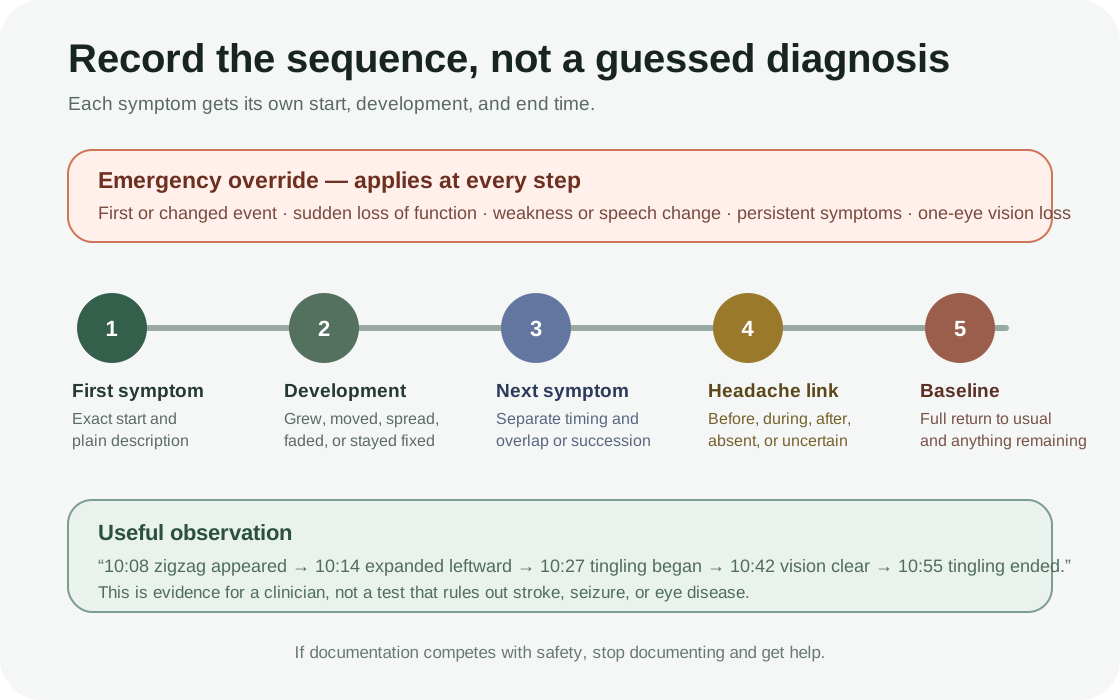
Build an aura observation strip
Do not translate observations into a diagnosis while recording them.
| Field | What to capture |
|---|---|
| First symptom | Plain description, exact/estimated start, sudden/gradual/uncertain |
| Development | Fixed, grew, moved, spread, faded, or changed quality |
| Each next symptom | Separate start/end; overlap, succession, or gap |
| Visual field | One eye, corresponding fields, both eyes, or uncertain—only if already known |
| Function | Reading, speaking, seeing, feeling, walking, working, or driving affected |
| Headache | Before/during/after/absent; start/end and migraine features |
| Baseline | Exact return to usual and anything that remained |
| Comparison | Same as established aura, different, first-ever, or uncertain |
If another person observed the episode, keep their account separately: “speech sounded slurred” is different evidence from “I could not find the word.” Preserve screenshots or drawings only when safe and effortless; never stare at a screen or delay care to document an emergency.
Frequently asked questions
Can migraine aura happen without a headache?
Yes. Typical aura without headache is a formal ICHD-3 subtype. A first painless neurological event still needs assessment because the absence of headache does not distinguish aura from TIA, seizure, or eye disease.
Can migraine aura last longer than an hour?
Individual non-motor symptoms typically last 5–60 minutes, but studies report longer symptoms in some people. New, unusually prolonged, persistent, or incompletely resolving symptoms need urgent evaluation rather than home classification.
Is blurry vision a migraine aura?
Not by itself. Aura usually produces a more specific reversible visual-field phenomenon that develops over minutes. Blur can also come from dry eye, focusing strain, prescription issues, medicines, or eye and neurological conditions.
Does aura always happen before head pain?
No. Aura may precede, overlap with, or occur without headache. Record the actual sequence rather than assuming the headache must start afterward.
Is seeing flashing lights always aura?
No. Retinal traction or detachment, eye inflammation, seizures, medicines, and other causes can produce flashes or visual phenomena. New flashes, many new floaters, a curtain-like shadow, one-eye loss, or persistent change needs prompt eye assessment.
Can I tell aura from stroke by timing it?
No. Gradual spread and positive symptoms are characteristic of aura, but stroke can sometimes show migraine-like features. A first, changed, sudden, persistent, or function-losing event needs emergency assessment regardless of the timer.
The useful rule: describe first, classify later
Migraine aura is a specific neurological pattern, not a catch-all for anything unusual before a headache. Record the first symptom, spread, sequence, duration, headache relationship, and full return to baseline. Let a clinician interpret that evidence—especially when the event is new or changed.
Preserve the sequence without delaying care
Calmraine can keep aura-like symptom timing beside headache, pain, medicines, and function in one private migraine record. It does not identify aura or distinguish an emergency. Explore the migraine tracker features.
Sources
- Migraine with auraInternational Headache Society · Accessed
- Migraine with brainstem auraInternational Headache Society · Accessed
- Headaches in over 12s: diagnosis and management—RecommendationsNICE · Accessed
- MigraineNational Institute of Neurological Disorders and Stroke · Accessed
- Migraine with aura—Symptoms and causesMayo Clinic · Accessed
- What does a migraine aura look like?—A systematic reviewThe Journal of Headache and Pain / PubMed Central · Accessed
- Migraine aura-like symptoms at onset of stroke and stroke-like symptoms in migraine with auraFrontiers in Neurology / PubMed Central · Accessed
- Visual Phenomena Associated With Migraine and Their Differential DiagnosisDeutsches Ärzteblatt International / PubMed Central · Accessed