
“Ocular migraine” usually describes a temporary visual disturbance related to migraine, but it is not a precise diagnosis. People use the phrase for migraine with visual aura, aura without headache, and the much rarer retinal migraine. The important question is not just what the episode looked like. It is whether the disturbance came from visual processing in the brain, one eye, or another neurological or eye condition.
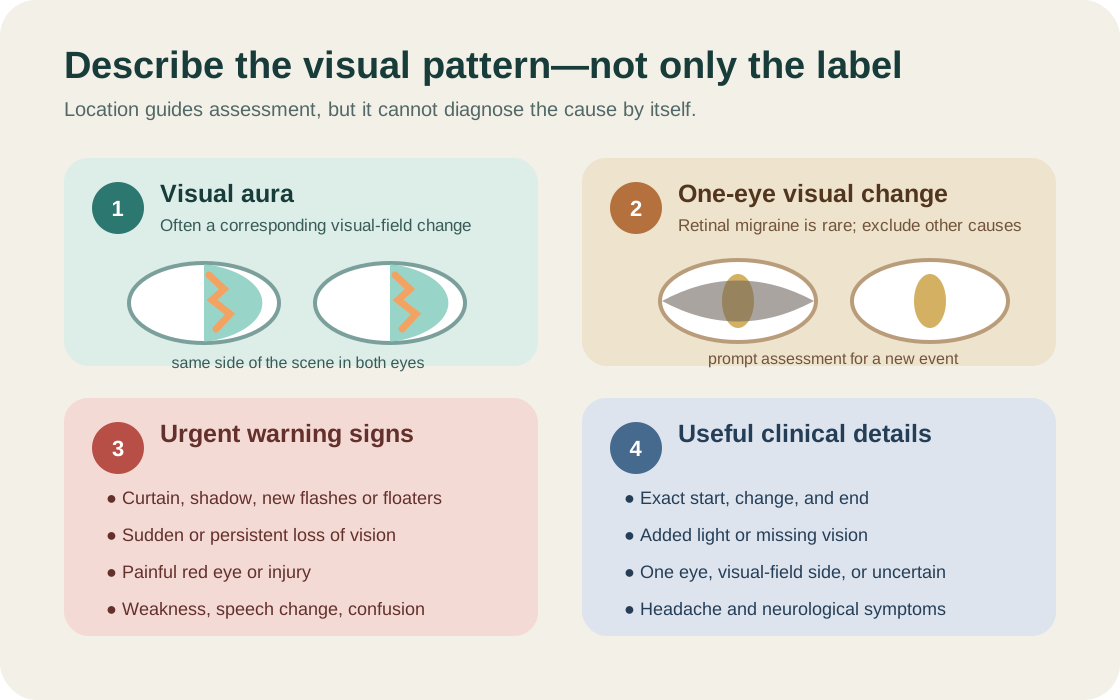
Visual aura often creates shimmering, zigzag, flashing, or missing areas in corresponding parts of both eyes’ visual fields. Retinal migraine, by contrast, is a formal diagnosis involving repeated, fully reversible symptoms in one eye after other causes have been excluded.
Get urgent medical help for a first or substantially changed visual event; sudden or persistent loss of vision; a curtain or shadow, many new floaters, or flashes; a painful red eye; weakness, speech difficulty, confusion, seizure, or fainting; or a sudden severe headache. Do not drive yourself or wait for headache to prove that the event is migraine.
What does “ocular migraine” mean?
Mayo Clinic explains that the term has commonly been used for two different conditions: migraine with visual aura and retinal migraine. A review of visual perception in migraine notes that terms such as ocular, ophthalmic, and monocular migraine are inconsistently used and do not appear as diagnoses in the International Classification of Headache Disorders (ICHD-3).
In everyday conversation, “ocular migraine” may refer to:
- a visual aura before or during migraine headache;
- a visual aura with no later headache, sometimes called silent migraine;
- a disturbance that seemed to affect one eye;
- a formally diagnosed retinal migraine; or
- an undiagnosed eye or neurological event incorrectly attributed to migraine.
That ambiguity is why a clinician needs a description of the actual visual experience, not only the label.
Visual aura, one-eye symptoms, and urgent eye signs
| Pattern | What a person may notice | What it means for next steps |
|---|---|---|
| Visual aura | Shimmering, zigzags, flashes, geometric shapes, or a changing blind area across part of the scene | Often arises from visual processing in the brain and involves corresponding visual fields from both eyes; first or changed events still need assessment |
| One-eye visual change | Dimming, a blind patch, flashing, or temporary loss perceived only through one eye | Retinal migraine is possible but rare; eye, retinal, optic-nerve, and vascular causes must be excluded |
| Retinal-detachment pattern | Sudden new flashes or many floaters, a fixed or growing curtain/shadow, or peripheral-field loss | Needs urgent eye assessment |
| Neurological emergency pattern | Visual change with weakness, facial droop, speech/language difficulty, confusion, seizure, fainting, or sudden severe headache | Needs emergency assessment |
The categories overlap. A person may believe a brain-generated visual-field defect is in one eye, and a serious one-eye event may be painless and temporary. “Both eyes” does not automatically mean harmless, and “one eye” does not automatically mean retinal migraine.
What ocular migraine symptoms can look like
Visual aura can include positive phenomena—something added to vision—and negative phenomena—something missing or reduced. Either may occur alone or together.
Common descriptions include:
- a flickering or shimmering spot that expands;
- jagged, zigzag, wavy, or C-shaped lines;
- stars, sparks, flashes, or geometric patterns;
- a blurred, gray, dim, or missing patch;
- words or faces that seem partly absent; or
- a moving edge around an area of reduced vision.
Aura commonly develops over minutes and changes position or size. ICHD-3 uses features such as gradual spread over at least five minutes, symptoms lasting 5–60 minutes, and headache during or within 60 minutes as parts of its classification—not as a home diagnostic checklist. Sudden onset, a fixed deficit, or an unusual duration can overlap with other conditions.
Why visual aura may seem to affect one eye
Visual information from both eyes is combined and processed at the back of the brain. A disturbance affecting the left side of the visual scene, for example, can be represented in the corresponding left visual field of both eyes. Because people normally view the world with both eyes open, it can feel as though the problem belongs to the eye on that side.
Clinicians therefore distinguish monocular vision—information from one eye—from a visual-field side shared by both eyes. They may ask what remained visible when each eye was covered during the event, but memory can be uncertain and testing should never delay urgent care. A drawing of the missing or shimmering area can sometimes communicate the pattern better than “left eye” or “right eye.”
Retinal migraine is rare
ICHD-3 defines retinal migraine as repeated attacks of fully reversible positive or negative visual symptoms in one eye, such as scintillations, a blind area, or blindness, associated with migraine headache. The one-eye pattern should be confirmed by a visual-field examination during an attack or by a carefully instructed drawing.
The classification calls retinal migraine an extremely rare cause of temporary monocular visual loss. It is a diagnosis of exclusion: other causes of transient one-eye vision loss, sometimes called amaurosis fugax, must be investigated first. A single unfamiliar episode should not be self-labeled retinal migraine merely because vision returned.
This page explains the term but does not replace the separate clinical work involved in diagnosing retinal migraine.
Can ocular migraine happen without a headache?
Yes—visual aura can occur without a headache. ICHD-3 recognizes typical aura without headache when an otherwise typical aura is not accompanied or followed by head pain. People sometimes call this an ocular migraine or silent migraine.
No headache does not identify the cause. A first episode of temporary visual loss, especially one perceived in one eye, still needs prompt assessment. New aura-like symptoms later in life, a changed pattern, or symptoms with vascular risk factors also deserve medical review because transient ischemic attack (TIA), eye disease, and seizure may overlap.
Ocular migraine vs. retinal detachment and other mimics
Several conditions can produce flashes, missing vision, blur, or unusual shapes:
- Retinal tear or detachment: new flashes, a sudden increase in floaters, or a curtain/shadow over vision are classic warning signs. The American Academy of Ophthalmology’s EyeWiki advises suspecting retinal tear with significant new flashes or persistent new floaters.
- Transient retinal or brain ischemia: sudden dimming or loss of vision may represent amaurosis fugax, TIA, or stroke, even when it resolves.
- Acute angle-closure glaucoma: severe eye pain, a red eye, blurred vision or halos, nausea, and headache require emergency eye care.
- Optic-nerve disease: vision loss, reduced color vision, or pain with eye movement can point away from typical visual aura.
- Occipital seizure: brief, stereotyped visual phenomena can resemble aura and may require neurological evaluation.
- Ordinary floaters, visual snow, and eye-surface blur: these can coexist with migraine but have different patterns and assessment needs.
The shape alone is rarely decisive. Onset, spread, duration, recurrence, eye versus field distribution, associated symptoms, examination, and sometimes imaging determine the diagnosis.
When to seek urgent help
Use urgent or emergency services for:
- first-ever, sudden, or substantially changed visual symptoms;
- loss or dimming of vision perceived in one eye;
- symptoms lasting less than five minutes, longer than an hour, or not fully resolving;
- a curtain, shadow, fixed field defect, many new floaters, or new flashes;
- severe eye pain, a red eye, injury, or marked change in visual clarity;
- weakness, numbness, facial droop, speech/language difficulty, confusion, seizure, or fainting;
- a sudden “worst” headache, fever with stiff neck, or persistent vomiting; or
- a new pattern during pregnancy/postpartum, after age 50, or with significant vascular risk.
These features do not prove an emergency diagnosis, but they are reasons not to assume migraine. If symptoms resolve before help arrives, the event can still need urgent investigation.
What to do during an established visual aura
If a clinician has already assessed the pattern as migraine aura and the current episode is typical for you:
- Stop driving, cycling, using machinery, or doing anything that depends on complete vision.
- Move to a safe place and reduce glare or visual demand if that feels more comfortable.
- Note the exact start time and what changed first.
- Follow the acute migraine plan agreed with your clinician.
- Escalate if the pattern differs in onset, side, symptoms, duration, severity, or recovery.
Light reduction may improve comfort during migraine-related photophobia, but a dark room does not treat an eye emergency. Avoid using symptom response—whether rest, caffeine, food, or medicine—as proof of the cause.
How clinicians assess visual symptoms
Assessment usually begins with a detailed history and neurological and eye-focused examination. The clinician may ask:
- Was the disturbance added light, lost vision, blur, or distortion?
- Did it begin suddenly or spread over minutes?
- Did it remain fixed, move, grow, or change shape?
- Was it one eye, one side of the visual scene, both eyes, or uncertain?
- How long did each symptom last, and did vision return completely?
- Were headache, nausea, light sensitivity, numbness, weakness, or language symptoms present?
- Is the pattern recurrent and previously assessed, or entirely new?
Depending on the answers and examination, evaluation may include a dilated retinal exam, visual-field testing, brain or blood-vessel imaging, blood tests, or referral to ophthalmology or neurology. The goal is to identify the source, not to make the episode fit a popular label.
Ocular migraine treatment
There is no single “ocular migraine treatment” because the phrase covers different conditions. Treatment follows the diagnosis.
For established migraine with visual aura, acute and preventive options are generally selected using the overall migraine pattern: attack frequency, headache symptoms, disability, other health conditions, pregnancy possibility, and medication use. A clinician may discuss migraine-specific acute medicines, nonprescription options when safe, anti-nausea treatment, or preventive therapy. The types of migraine guide explains why subtype and symptom pattern matter.
One-eye vision loss, retinal disease, glaucoma, TIA, stroke, and seizure require different care. Do not start, stop, or combine medicines based on an online “ocular migraine” label. If visual symptoms make oral medicine difficult to take early, ask a clinician about the timing and formulation of an agreed plan.
A useful visual-event record
Write down what happened after urgent needs are addressed. Preserve uncertainty rather than filling gaps.
| Record | Useful detail |
|---|---|
| Start and end | Clock time for each visual and neurological symptom |
| Visual description | Added light/shape, missing patch, dimming, blur, color change, curtain, or floaters—in your own words |
| Distribution | One eye, corresponding side of both visual fields, both eyes generally, or uncertain |
| Evolution | Sudden, spreading, moving, enlarging, fixed, or intermittent |
| Associated features | Headache, nausea, light sensitivity, eye pain/redness, weakness, numbness, speech change, or confusion |
| Context | First event, similarity to assessed episodes, injury, illness, pregnancy/postpartum, medicines, and return to baseline |
A simple sketch of the scene can help. This record supports clinical history; it cannot determine whether the event was aura, retinal migraine, or another condition.
Frequently asked questions
How long does an ocular migraine last?
Typical visual aura symptoms commonly last 5–60 minutes, although the complete migraine attack can last much longer. Retinal migraine criteria also use a 5–60-minute range. Duration alone cannot diagnose either condition, and an unfamiliar episode outside that range needs prompt assessment.
Is ocular migraine dangerous?
Migraine visual aura is usually fully reversible, but similar symptoms can come from urgent eye, retinal, vascular, or neurological conditions. The risk is assuming that a first or changed event is migraine without assessment.
Does ocular migraine affect one eye or both?
Visual aura usually affects corresponding parts of both eyes’ visual fields because it arises in brain visual processing. Formal retinal migraine affects one eye, but it is extremely rare. A new one-eye visual change needs prompt medical evaluation.
Can I drive with an ocular migraine?
No. A visual disturbance can hide vehicles, pedestrians, text, or part of the road. Stop safely and do not resume driving until vision is fully normal and the episode has been appropriately assessed.
Can screens cause ocular migraine?
Bright light, glare, visual strain, sleep disruption, or prolonged tasks may be associated with attacks for some people, but a screen exposure does not prove the diagnosis or explain one-eye vision loss. Track repeated context without treating a single coincidence as a confirmed trigger.
The practical takeaway
“Ocular migraine” is a starting phrase, not a final diagnosis. Most usage refers to visual migraine aura, while retinal migraine is a rare, repeated one-eye syndrome diagnosed only after other causes are excluded. Describe the visual field, timeline, and associated symptoms precisely; seek urgent care for first, changed, one-eye, persistent, or emergency-pattern symptoms; and use a diagnosis-specific treatment plan rather than treating the label itself.
Read the detailed migraine aura guide for visual, sensory, and language-aura patterns, and review the medical disclaimer.
Sources
- Ocular migraine—When to seek helpMayo Clinic · Accessed
- Retinal migraineInternational Headache Society · Accessed
- Migraine with auraInternational Headache Society · Accessed
- Visual perception in migraine—A narrative reviewVision / PubMed Central · Accessed
- Understanding ocular migraineAmerican Migraine Foundation · Accessed
- Visual Phenomena Associated With Migraine and Their Differential DiagnosisDeutsches Ärzteblatt International / PubMed Central · Accessed
- Retinal detachmentAmerican Academy of Ophthalmology EyeWiki · Accessed