
The main types of migraine are migraine without aura, migraine with aura, and chronic migraine. Aura has formal subtypes, while menstrual migraine, vestibular migraine, abdominal migraine, and labels such as “ocular” or “silent migraine” sit in different parts of the classification—or are informal terms that need translation.
One person can have attacks with and without aura, and chronic migraine can include migraine-like and tension-type-like headache days. The type is determined from the full history, not one symptom or an online quiz.
Seek urgent medical help for a sudden extremely severe headache; new weakness, speech difficulty, confusion, seizure, or fainting; sudden or persistent vision loss; or new neurological symptoms that are different from an established aura pattern. Vision loss perceived in one eye needs prompt eye and medical assessment rather than an “ocular migraine” assumption.
Types of migraines and related labels
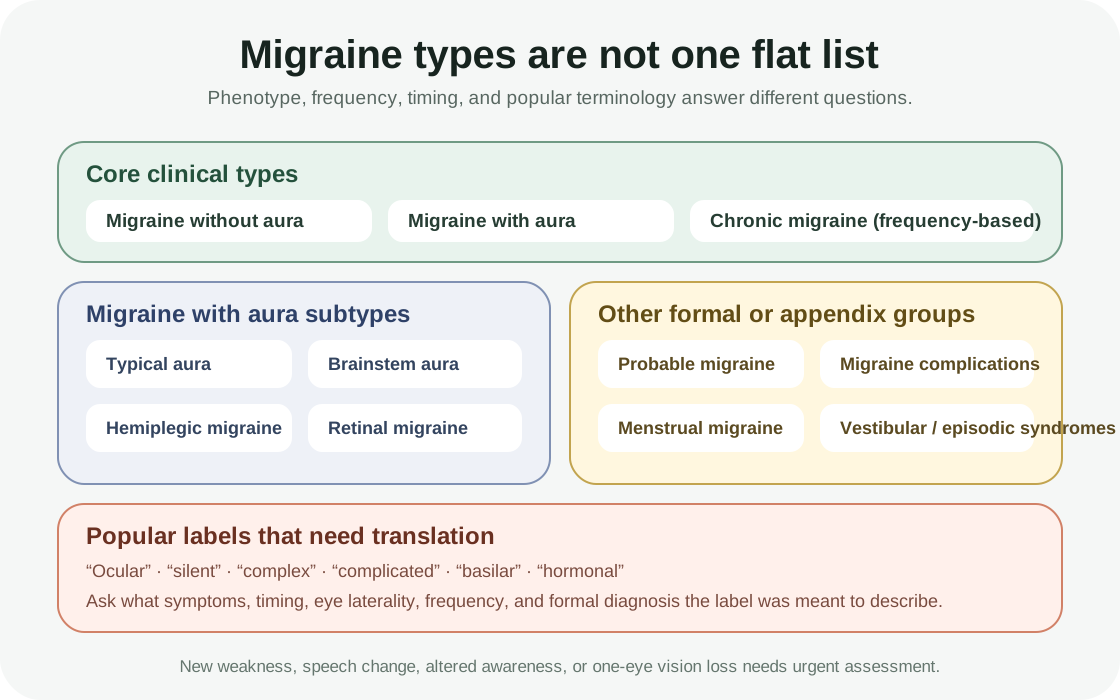
The ICHD-3 migraine section calls migraine without aura and migraine with aura the two major phenotype types. Clinical practice also treats chronic migraine as a main type because frequency changes diagnosis and management. The rest of the map includes aura subtypes, complications, probable migraine, episodic syndromes, and appendix classifications.
The three main clinical migraine types
| Type | What defines the category | What it does not mean |
|---|---|---|
| Migraine without aura | Recurrent migraine-pattern headache attacks without qualifying focal neurological aura | “Without warning” or without sensory sensitivity |
| Migraine with aura | Recurrent fully reversible visual, sensory, speech/language, motor, brainstem, or retinal neurological symptoms with a characteristic sequence and timing | Any blurry vision, dizziness, tingling, or light sensitivity |
| Chronic migraine | At least 15 headache days per month for more than 3 months, with migraine features on at least 8 days per month | One unusually long attack or “very severe migraine” |
These categories can overlap. Someone may have attacks with aura and attacks without aura. If headache frequency crosses the chronic threshold, chronic migraine can incorporate both attack phenotypes.
Migraine without aura
Migraine without aura is the most familiar attack pattern. Untreated or unsuccessfully treated headache typically lasts 4–72 hours in adults. Common features include:
- one-sided or bilateral pain;
- throbbing, pulsing, pressure, or aching quality;
- moderate or severe intensity;
- worsening with walking, stairs, bending, or other routine movement;
- nausea or vomiting; and
- sensitivity to light and sound.
The formal diagnosis uses a combination of these features across repeated attacks. Not every attack must be one-sided or pulsating, and photophobia alone is not enough. The light-sensitivity guide explains why eye and neurological contexts still matter.
Migraine with aura
Migraine aura consists of fully reversible focal neurological symptoms that usually develop gradually over minutes. Visual aura is most common, but sensory and speech/language symptoms also occur. Symptoms may spread or occur in succession and are commonly followed by headache, though headache can be absent.
Examples include a growing zigzag or shimmering area in vision, pins-and-needles that slowly travel up an arm, numbness after tingling, or temporary word-finding difficulty. Sudden fixed loss of function is less typical and needs urgent assessment.
Aura is not the same as:
- photophobia or painful brightness;
- ordinary eye floaters;
- blur from dry eye or an incorrect prescription;
- dizziness without other qualifying features;
- prodrome symptoms such as fatigue or yawning; or
- every neurological symptom that happens near a headache.
ICHD-3 requires a structured combination of symptom type, reversibility, development, duration, laterality, positive features, and headache timing. A diary can preserve those facts but should not score a home diagnosis.
Typical aura: visual, sensory, or speech symptoms
Typical aura includes visual, sensory, and/or speech/language symptoms without motor weakness, brainstem symptoms, or retinal symptoms. It has two named forms:
- typical aura with headache, when headache accompanies or follows the aura; and
- typical aura without headache, when a qualifying headache does not occur within the defined period.
“Silent migraine” is often used for the second pattern, but the everyday label is imprecise. A first episode without headache can be especially difficult to distinguish from a transient ischemic attack, seizure, or eye problem. New symptoms require assessment before they are treated as familiar aura.
Migraine with brainstem aura
Migraine with brainstem aura includes at least two fully reversible brainstem symptoms and no motor or retinal symptoms. The formal list includes dysarthria, vertigo, tinnitus, reduced hearing, double vision, ataxia, and decreased level of consciousness.
Ordinary lightheadedness is not the same as vertigo, and a muffled ear is not automatically hypacusis. Motor weakness instead routes the classification toward hemiplegic migraine. Because stroke and other disorders can produce overlapping symptoms, new double vision, severe imbalance, reduced consciousness, or speech change needs urgent medical evaluation.
The older term basilar migraine is no longer preferred because it implied a basilar-artery mechanism that is not established.
Hemiplegic migraine
Hemiplegic migraine is migraine with aura that includes fully reversible motor weakness, along with other reversible visual, sensory, or speech/language symptoms. ICHD-3 separates:
- familial hemiplegic migraine, when at least one close relative has attacks meeting the same criteria; and
- sporadic hemiplegic migraine, when that family history is absent.
Weakness can overlap with stroke. A first episode, a changed episode, or weakness without an already evaluated and established pattern is an emergency. Family history does not safely rule out stroke, and genetic subtype cannot be inferred from symptoms alone.
Retinal migraine is rare and monocular
Retinal migraine is a rare diagnosis involving repeated, fully reversible visual phenomena perceived in one eye, associated with migraine, after other causes of temporary monocular vision loss have been excluded. It is different from typical visual aura, which arises in the brain and usually affects corresponding parts of both eyes’ visual fields even if it seems one-sided.
The phrase “ocular migraine” is used inconsistently for both visual aura and retinal migraine. Do not rely on it. New one-eye dimming, blindness, flashing, or a curtain-like effect needs prompt eye and medical assessment because retinal and vascular disorders can threaten vision.
Covering one eye and then the other during an event may help describe perception if it can be done safely, but it cannot diagnose the source and should never delay urgent care.
Chronic migraine vs. episodic migraine
ICHD-3 defines chronic migraine as headache on at least 15 days per month for more than 3 months, with migraine features on at least 8 days per month. Some days may feel migraine-like and others tension-type-like, which is why every headache day matters.
Episodic migraine is commonly used for migraine below the chronic frequency threshold. It is useful shorthand, but frequency can change over time. Neither term describes pain intensity: episodic attacks can be extremely disabling, while chronic migraine includes milder headache days.
Use a calendar rather than multiplying remembered attack count by average duration. A three-day attack is three headache days, not one. Also record acute-medicine days because medication overuse may coexist and influence the pattern.
Probable migraine
Probable migraine is a formal ICHD-3 category for attacks that meet all but one required feature of migraine without aura or migraine with aura and are not better explained by another diagnosis. It is not “probably nothing,” a milder stage, or permission to ignore red flags.
The label can be useful while a clinician gathers more attacks or clarifies one missing dimension. A high-quality diary records episodes that do not fit neatly instead of editing them to match the suspected type.
Menstrual migraine classifications
Pure menstrual migraine and menstrually related migraine appear in the ICHD-3 appendix and are defined around migraine without aura from day −2 through day 3 of menstruation in at least two of three cycles.
- Pure menstrual migraine: qualifying attacks occur in that window and not at other cycle times.
- Menstrually related migraine: qualifying attacks occur in the window and also at other times.
People can still have aura or headaches at other cycle points; the formal appendix labels have narrower criteria. The menstrual migraine guide explains cycle tracking, acute treatment, mini-prevention, contraception, and reproductive-stage considerations.
Vestibular migraine
Vestibular migraine is recognized through consensus criteria and appears in the ICHD-3 appendix. It involves repeated moderate or severe vestibular episodes in someone with a migraine history, with migraine features during at least half of those episodes, after other causes are considered.
Vestibular symptoms can include spontaneous or positional vertigo, visually induced vertigo, head-motion-induced vertigo, or head-motion dizziness with nausea. Headache does not have to accompany every episode.
Vestibular migraine is not the same as migraine with brainstem aura. ICHD-3 notes that their episode timing and criteria differ. New severe imbalance, inability to walk, double vision, weakness, speech change, or continuous new vertigo requires urgent assessment for stroke and other causes.
Abdominal migraine and episodic syndromes
ICHD-3 places abdominal migraine under episodic syndromes that may be associated with migraine. It occurs mainly in children and involves recurrent midline abdominal pain with nausea, vomiting, pallor, or loss of appetite, with normal health between episodes. Headache does not occur during the abdominal episodes under ICHD-3 criteria.
The group also includes cyclical vomiting syndrome and benign paroxysmal vertigo. These are not simply “migraine pain in a different body part.” Gastrointestinal, metabolic, structural, seizure, and other explanations require evaluation. The abdominal migraine guide covers the child-focused differential and family record.
Migraine complications are not ordinary subtypes
ICHD-3 lists four complications of migraine:
- status migrainosus;
- persistent aura without infarction;
- migrainous infarction; and
- migraine aura-triggered seizure.
These are uncommon clinician diagnoses with specific criteria. A long attack is not automatically status migrainosus, persistent visual symptoms are not safe to classify at home, and a stroke during a person’s lifetime is not automatically migrainous infarction. The migraine-duration guide explains when prolonged or changed symptoms need care.
Translate popular migraine labels before using them
| Popular label | What it may refer to | Better question |
|---|---|---|
| Ocular migraine | Typical visual aura or retinal migraine | Did the change involve one eye or corresponding visual fields, and was it fully reversible? |
| Silent migraine | Typical aura without headache | What exact neurological symptom developed, spread, ended, and recurred? |
| Complex or complicated migraine | Aura with unusual, prolonged, speech, sensory, or motor symptoms; usage varies | What formal diagnosis did the clinician mean? |
| Basilar migraine | Older name for migraine with brainstem aura | Which brainstem symptoms were present, and was motor weakness absent? |
| Hormonal migraine | Migraine perceived around a hormonal transition | Is there a repeated, prospectively recorded timing pattern? |
| Sinus migraine | Usually an informal description of migraine with facial pressure or nasal symptoms | Was rhinosinusitis actually diagnosed, and what migraine features occurred? |
| Vestibular migraine | A consensus-defined vestibular disorder associated with migraine | Did episodes meet the vestibular timing and migraine-feature pattern? |
If a medical record uses an ambiguous label, ask for the ICHD diagnosis or a plain-language description. The label should help future clinicians understand the pattern, not conceal it.
Can one person have more than one migraine type?
Yes. ICHD-3 says each type or subtype can be diagnosed when its criteria are met. A person may have migraine with aura and migraine without aura. Menstrual timing may describe some attacks, while other attacks occur outside the cycle window. Chronic migraine can include multiple attack phenotypes.
The pattern can also change with age, pregnancy, menopause, medicines, illness, or no obvious reason. A new type of neurological symptom should be assessed rather than automatically added to an existing migraine label.
How migraine type is diagnosed
Migraine diagnosis is based mainly on history and neurological examination. There is no routine scan or blood test that confirms a migraine type. Tests are selected when the story or examination suggests another cause.
A clinician will usually ask about:
- age at onset and family history;
- attack frequency, duration, and headache-free days;
- pain location, quality, severity, and movement response;
- nausea, light/sound sensitivity, and functional impairment;
- prodrome and postdrome features;
- each aura-like symptom’s start, spread, sequence, end, and reversibility;
- one-eye versus visual-field perception;
- vertigo, weakness, speech, consciousness, and seizure symptoms;
- cycle timing, pregnancy/postpartum context, injury, and illness; and
- acute/preventive medicines and total use days.
The 2021 European consensus recommends a careful history that also screens for secondary-headache red flags and medication overuse. Formal criteria support consistency; they do not replace clinical judgment.
Use a migraine feature matrix
Record each episode as observed rather than starting with a subtype guess.
| Dimension | Episode A | Episode B | Episode C |
|---|---|---|---|
| Headache start/end and headache-free return | |||
| Pain, movement response, nausea, light/sound sensitivity | |||
| Aura-like symptom start, spread, sequence, end | |||
| Visual change: one eye, both visual fields, or uncertain | |||
| Vertigo, speech, strength, sensation, awareness | |||
| Acute medicine time, response, recurrence | |||
| Cycle/illness/injury/other context | |||
| Similar episode without suspected factor |
Keep “uncertain” available. False precision—especially about eye laterality or aura duration remembered days later—can mislead more than a clearly marked unknown.
Frequently asked questions
What is the most common type of migraine?
Migraine without aura is more common than migraine with aura. Population proportions vary by study and are less useful for identifying an individual pattern than the actual presence or absence of qualifying aura.
Is migraine with aura more severe?
Not necessarily. Aura describes transient neurological symptoms, not pain intensity. Migraine without aura can be extremely disabling, and some aura occurs without headache.
Is chronic migraine a permanent condition?
No. Chronic describes the current frequency pattern, not an irreversible state. People can move between chronic and episodic frequency. Treatment, medication overuse, life stage, health conditions, and natural variation can all affect the course.
Is vestibular migraine a type of aura?
No. Vestibular migraine and migraine with brainstem aura have different criteria. Vertigo can occur in both, but vestibular episodes do not automatically qualify as aura.
Does ocular migraine mean one-eye migraine?
Not reliably. The term is used for visual aura and retinal migraine. Because new one-eye vision loss has other potentially urgent causes, describe the exact visual change and seek prompt assessment.
Can a migraine type change?
Yes. A person’s frequency, aura status, timing associations, and dominant symptoms can change. A genuinely new or substantially changed neurological pattern needs evaluation before it is accepted as migraine evolution.
Use the type as a working description
A migraine label should organize evidence: aura phenotype, frequency, timing, vestibular or abdominal features, and response over time. It should never erase symptoms that do not fit. When a popular label is ambiguous, translate it back into what happened.
Record the features behind the label
Calmraine can keep headache days, pain, aura-like symptoms, medicines, cycle timing, and function together in one private migraine timeline. It does not diagnose a migraine type. Explore the migraine tracker features.
Sources
- MigraineInternational Headache Society · Accessed
- Migraine with auraInternational Headache Society · Accessed
- Chronic migraineInternational Headache Society · Accessed
- Vestibular migraineInternational Headache Society · Accessed
- MigraineNational Institute of Neurological Disorders and Stroke · Accessed
- Diagnosis and management of migraine in ten stepsNature Reviews Neurology / PubMed Central · Accessed
- Migraine with aura—Symptoms and causesMayo Clinic · Accessed
- What Type of Headache Do You Have?American Migraine Foundation · Accessed