
Frequent headaches are recurring headaches that happen often enough to concern you, disrupt life, or require repeated medicine—but “frequent” is not a diagnosis and has no single universal cutoff. A weekly headache deserves attention if it is new, worsening, disabling, or driving regular medication use. Headache on 15 or more days per month is a formal high-frequency boundary used in several chronic headache diagnoses.
Common explanations include migraine, tension-type headache, a worsening episodic headache disorder, medication-overuse headache, sleep or caffeine changes, and another medical condition. The fastest route to clarity is to count calendar headache days and medicine-use days, describe the recurring pattern, and arrange care based on change, disability, and warning signs—not frequency alone.
Get emergency help for a headache that reaches maximum intensity within a minute, or headache with new weakness/numbness, speech trouble, confusion, fainting, seizure, sudden persistent vision loss, fever with marked neck stiffness, or a painful red eye with blurred vision.
Preparing to discuss a changing pattern? The free migraine appointment prep builder organizes the goal, changes, records, and questions into one private summary.
How frequent is too frequent for headaches?
There is no number below which headache is automatically harmless. Context changes the answer:
- One new severe headache can be more urgent than months of stable mild headaches.
- One headache every week is roughly four headache days per month and may justify routine assessment when attacks are disabling or treatment is not working.
- Headache on 8–14 days per month is high frequency even though it remains below the chronic-migraine boundary.
- Headache on 15 or more days per month for more than three months is a chronic pattern that needs diagnostic classification.
- A daily headache that began abruptly and became continuous is different from attacks that gradually became more frequent.
Book a clinician visit when frequency is rising, headaches interfere with ordinary activities, acute medicine is needed repeatedly, the diagnosis is uncertain, or your existing plan is no longer controlling attacks. You do not need to wait until day 15.
A 30-day frequent-headache map
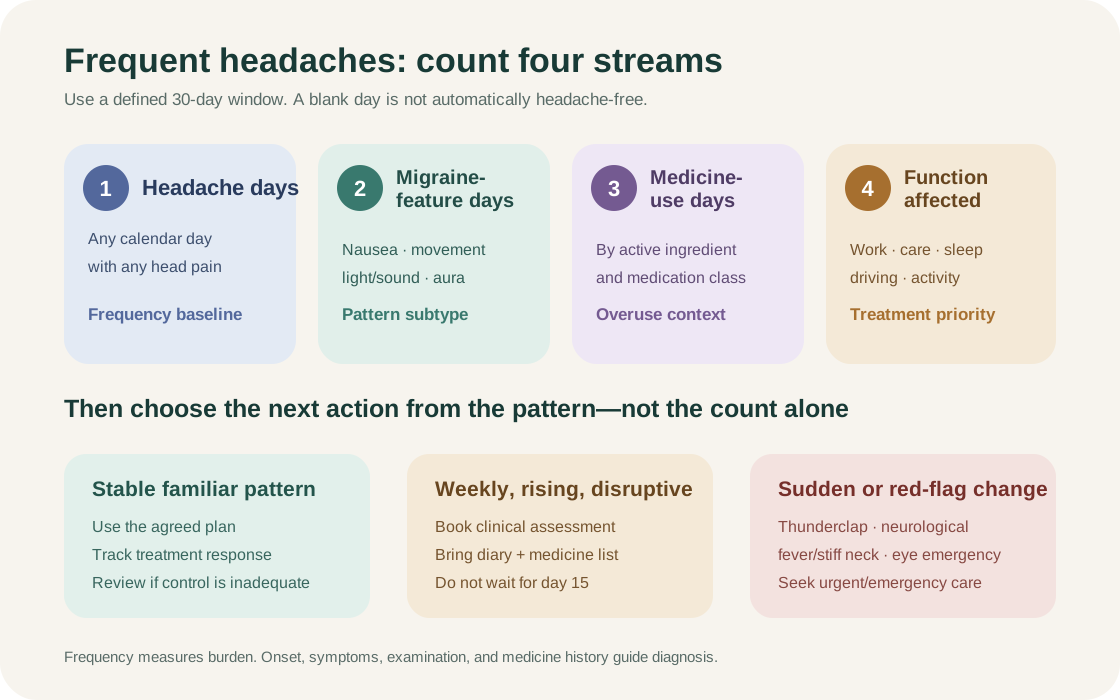
| What to count | Why it matters |
|---|---|
| Headache days | Every calendar day with any head pain, including mild or partial days |
| Migraine-feature days | Days with nausea, movement sensitivity, light/sound sensitivity, aura, or another established migraine pattern |
| Medication-use days | Each calendar day an acute headache or pain medicine is taken, recorded by active ingredient/class |
| Function | Work, school, care, sleep, driving, exercise, or social activity reduced or missed |
Attack count is useful too, but it is not interchangeable with headache-day count. One attack can cross midnight and touch multiple calendar days; several short attacks can happen in one day.
Common causes and patterns of frequent headaches
Migraine
Migraine can cause recurrent moderate or severe attacks with nausea, light/sound sensitivity, and pain worsened by ordinary movement. Pain may throb or feel like pressure and can be one-sided or bilateral. Some people have aura. As migraine becomes frequent, individual days may look less textbook and a low-grade background headache can sit between stronger flares.
Tension-type headache
Tension-type headache commonly feels like bilateral pressing or tightening of mild-to-moderate intensity. Routine movement usually does not worsen it, nausea is absent, and light or sound sensitivity—if present—is limited. Frequent episodic and chronic forms use defined day-count and duration criteria. “Tension” names the pattern; it does not prove stress or tight muscles are the cause.
Chronic migraine and other chronic daily headaches
Chronic migraine means at least 15 headache days per month for more than three months, including at least eight days with migraine features or another qualifying migraine connection. Other chronic daily patterns include chronic tension-type headache, new daily persistent headache, and hemicrania continua. Their onset, laterality, associated symptoms, and treatment responses differ.
Medication-overuse headache
Frequent use of acute headache medicines can sustain or worsen a high-frequency pattern in a susceptible person. Medication-overuse headache requires at least 15 headache days per month plus more than three months of class-specific overuse. The threshold is 10 or more days per month for triptans, opioids, ergotamines, combination pain relievers, or mixed-class use, and 15 or more days for simple non-opioid analgesics.
Those are diagnostic thresholds—not safe-use targets. Do not abruptly stop opioids, butalbital-containing products, benzodiazepines, or other dependence-forming medicine without guidance. See rebound headaches and medication overuse for the complete withdrawal and prevention framework.
Sleep, caffeine, meals, hydration, and sensory load
Inconsistent sleep, sleep apnea, caffeine withdrawal or fluctuating intake, missed meals, dehydration, prolonged screen/near work, and sustained sensory exposure may precede or amplify headaches. These observations can guide controlled changes, but they should not automatically become the diagnosis. For example, morning headache plus loud snoring and daytime sleepiness deserves sleep-apnea assessment rather than only more water.
Secondary headaches
A secondary headache is caused by another condition. Possibilities range from viral illness, eye or dental disease, head injury, and medicine effects to uncommon vascular, pressure, inflammatory, infectious, or structural disorders. Most recurring primary-care headaches are not caused by a dangerous brain problem, but red flags and examination findings determine who needs urgent testing.
What pattern details narrow the possibilities?
The most useful clues describe how the headaches behave:
- Onset: sudden versus gradual; exact day a continuous headache began.
- Duration: minutes, hours, days, or never fully absent.
- Location: one side, both sides, eye/temple/occiput, or changing.
- Quality: pressure, throbbing, stabbing, electric, burning, or explosive.
- Activity response: worse with walking/stairs versus unchanged.
- Associated symptoms: nausea, sensory sensitivity, tearing/nasal symptoms, aura, fever, jaw pain, eye redness, or neurological change.
- Timing: on waking, after meals, during sleep, around menstruation, on workdays, or after exertion/cough/sex.
- Baseline change: stable familiar pattern versus escalating frequency or a new phenotype.
- Recovery: fully normal between attacks versus continuous background pain.
Location alone cannot identify a cause. Use it as one part of the pattern, not a diagnosis chart.
When frequent headaches are an emergency
Call emergency services or seek emergency care for:
- thunderclap onset—maximum intensity within a minute;
- new facial droop, weakness, numbness, speech/language trouble, confusion, collapse, or seizure;
- fever with severe headache, marked neck stiffness, rash, or impaired awareness;
- sudden persistent vision loss, or severe eye pain/redness with halos or blurred vision;
- severe headache after a significant head injury;
- severe headache with pregnancy/postpartum warning signs such as high blood pressure, visual change, or neurological symptoms; or
- a rapidly worsening headache with repeated vomiting, severe dehydration, or inability to remain awake.
Pain intensity alone does not decide the cause, and relief after pain medicine does not prove a headache was benign.
When to book a non-emergency appointment
Arrange prompt or routine assessment—depending on severity and context—when:
- headaches are happening weekly or becoming more frequent;
- acute treatment is needed on multiple days most weeks;
- work, school, care, sleep, or exercise is repeatedly affected;
- a new headache begins after age 50;
- headaches are new with cancer, immune suppression, pregnancy/postpartum status, or a recent medication change;
- attacks are triggered by cough, exertion, sex, or position;
- the pattern is consistently one-sided, wakes you from sleep, or is continuous from a clearly remembered start; or
- an established treatment plan is ineffective or causing adverse effects.
These features do not all mean emergency disease. They change the urgency and scope of clinical evaluation.
What you can do now
For a familiar headache without warning signs:
- Pause unsafe activities and reduce sensory demand.
- Eat and hydrate if intake has been delayed and it is safe to do so.
- Use the acute treatment already recommended for your diagnosed pattern, following dose and spacing instructions.
- Record the day and medicine before memory becomes imprecise.
- Avoid stacking products without checking active ingredients; cold/flu and combination brands can duplicate acetaminophen/paracetamol, NSAIDs, caffeine, or sedating ingredients.
- Schedule assessment rather than repeatedly escalating nonprescription treatment if headaches continue.
Regular sleep/wake timing, meals, hydration, and gradual activity can support headache control. These foundations are not a substitute for acute or preventive migraine treatment, and persistent headache is not evidence that you failed at lifestyle.
How frequent headaches are evaluated
Diagnosis starts with a history and physical/neurological examination. A clinician may check blood pressure, eyes, neck/jaw, medication list, and signs relevant to infection, vascular disease, sleep disorders, or another suspected cause. They will classify the pattern as a likely primary headache, possible secondary headache, or still uncertain.
Brain imaging is not automatically needed for a stable headache pattern that meets primary-headache criteria and has a normal examination. CT is often used in emergency settings; MRI may be preferred for selected concerning non-emergency patterns. Blood tests, eye assessment, lumbar puncture, sleep testing, or other studies are chosen for specific clues—not as a universal “headache panel.”
Bring actual medicine packages or photographs, including nonprescription, cold/flu, menstrual, dental, and other pain products. The active ingredients matter more than the brand name.
Build a useful 30-day record
NICE recommends recording frequency, duration, severity, associated symptoms, medicines, possible factors, and menstrual relationship when relevant. Keep the daily version short enough to complete:
- headache: yes/no/uncertain;
- worst intensity and hours affected;
- migraine features or unusual symptoms;
- exact acute medicine and response;
- functional impact; and
- one brief context note only when something changed.
Mark true headache-free days; do not treat blanks as zeros. If you reconstruct a past month, label estimates. At the end of 30 days, total headache days, migraine-feature days, medicine-use days by class, and substantially impaired days. Those four totals are usually more useful than a long list of suspected triggers.
Frequently asked questions
Why am I getting headaches every day?
Daily headache can reflect chronic migraine, chronic tension-type headache, medication overuse, new daily persistent headache, hemicrania continua, or a secondary cause. The exact onset and whether pain ever fully stops are important. A new daily or steadily worsening pattern needs assessment.
Are frequent headaches a sign of a brain tumor?
Most frequent headaches are not caused by a brain tumor. Concern rises with an abnormal neurological examination, cancer history, seizures, progressive pattern, personality/cognitive change, or other red flags. Imaging decisions should follow the full clinical picture.
Can stress cause frequent headaches?
Stress can precede or amplify migraine and tension-type headache, but frequent headache should not be dismissed as “just stress.” Sleep disruption, muscle bracing, missed meals, and delayed treatment may travel with stress. Track the sequence and assess persistent change.
Is a headache every week normal?
A weekly headache is not automatically dangerous, but it is worth discussing when new, disabling, increasing, or requiring repeated medicine. Effective acute and preventive treatment can be considered well before a pattern becomes chronic.
How many headache days are considered chronic?
Several chronic headache diagnoses use at least 15 headache days per month for more than three months, but the additional criteria differ. Chronic migraine also requires at least eight qualifying migraine-feature days. A day count alone does not determine the diagnosis.
The practical takeaway
Frequent headaches are a pattern to investigate, not a diagnosis to accept. Count headache days, migraine features, medicine-use days, and lost function over a defined window. Seek emergency care for sudden or neurological/systemic warning signs; book assessment when headaches are weekly, escalating, disruptive, or driving repeated medicine use. A clear 30-day history helps a clinician distinguish migraine, tension-type headache, medication overuse, other chronic daily patterns, and secondary causes—and choose treatment before the pattern consumes more of the month.
For broader classification, read different kinds of headaches, migraine vs. headache, and the medical disclaimer.
Sources
- Headaches in over 12s—RecommendationsNICE · Accessed
- HeadacheNational Institute of Neurological Disorders and Stroke · Accessed
- Chronic daily headachesMayo Clinic · Accessed
- Chronic migraineInternational Headache Society · Accessed
- Medication-overuse headacheInternational Headache Society · Accessed
- Frequent headaches—Evaluation and managementAmerican Family Physician · Accessed
- Headache journals—Tracking your migraineAmerican Migraine Foundation · Accessed