
Rebound headaches are now formally called medication-overuse headache (MOH): a pattern in which frequent use of acute headache medicine contributes to headache on at least 15 days per month in someone with a pre-existing headache disorder. It develops over time, not from taking one appropriate dose during a bad attack.
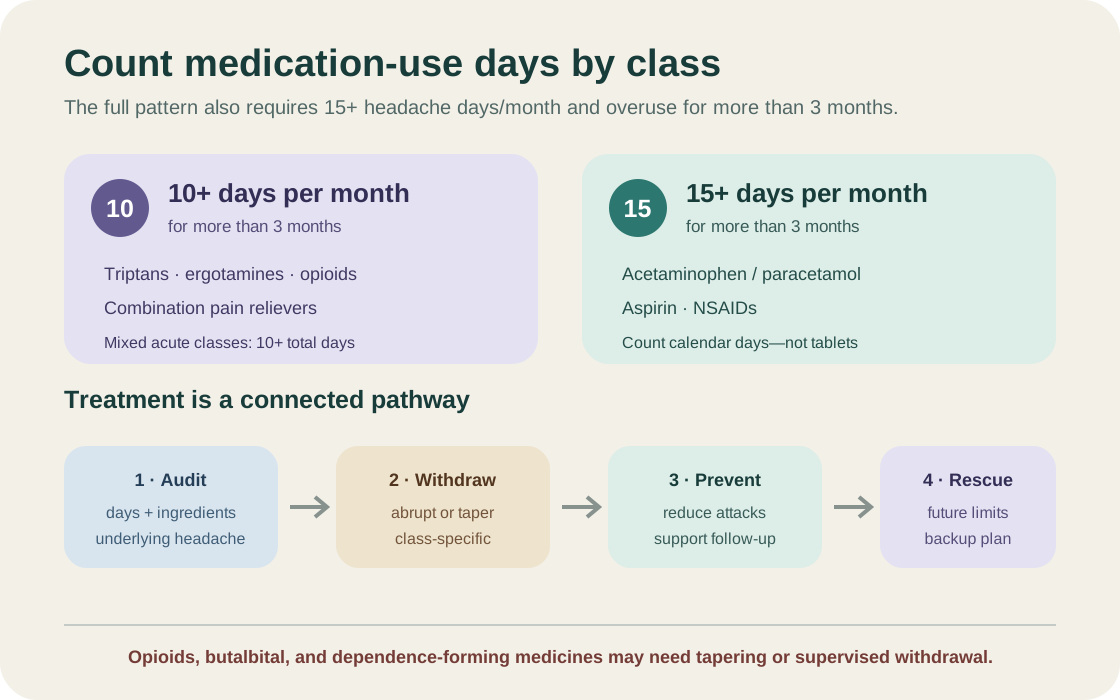
The medication-use threshold depends on the class. Triptans, ergotamines, opioids, and combination pain relievers meet the ICHD-3 overuse threshold at 10 or more days per month for more than three months. Simple non-opioid pain relievers such as acetaminophen/paracetamol, aspirin, or NSAIDs meet it at 15 or more days per month for more than three months. Mixed use across several classes can meet a 10-day threshold even when no single class does.
Treatment usually combines reducing or withdrawing the overused acute medicine, treating the underlying migraine or tension-type headache preventively, and creating a sustainable future rescue plan. Do not abruptly stop opioids, butalbital-containing products, benzodiazepines, or another dependence-forming medicine without medical guidance; withdrawal may require tapering or supervised care.
Want a neutral count before interpreting it? Use the free headache medication-days calendar to mark dates and your own medication labels without generating a diagnosis.
Rebound headache thresholds by medication class
| Acute medication class | ICHD-3 overuse threshold |
|---|---|
| Triptans | At least 10 days/month for more than 3 months |
| Ergotamines | At least 10 days/month for more than 3 months |
| Opioids | At least 10 days/month for more than 3 months |
| Combination analgesics, including many caffeine- or butalbital-containing products | At least 10 days/month for more than 3 months |
| Acetaminophen/paracetamol | At least 15 days/month for more than 3 months |
| Aspirin or other NSAIDs | At least 15 days/month for more than 3 months |
| Multiple acute classes, none individually overused | Combined total of at least 10 days/month for more than 3 months |
These are diagnostic overuse thresholds, not recommended targets. A clinician may set a lower future use limit based on the medicine, underlying headache, other health risks, and previous MOH.
How medication-use days are counted
Count calendar days, not tablets, doses, or separate attacks.
- Two triptan doses on Monday count as one triptan-use day.
- Ibuprofen in the morning and a triptan that evening still occur on one calendar day, but both classes should be recorded.
- A combination product counts on the day it is used; record all active ingredients.
- Medicine taken for back, dental, menstrual, or other pain still matters if it belongs to a relevant analgesic class.
- Caffeine from a combination headache product should be distinguished from coffee or tea, while total caffeine context is still useful.
Do not “save” medicine use by taking extra doses on a use day. Product maximums, dose spacing, liver/kidney/GI risk, sedation, and cardiovascular safety still apply independently of MOH counting.
Rebound headache symptoms
There is no unique rebound-headache sensation. The pain often resembles the underlying migraine or tension-type headache and can change from day to day.
Possible patterns include:
- headache on most days or every day;
- a headache present on waking or returning as medicine wears off;
- increasingly frequent migraine-like attacks;
- temporary relief followed by recurrence;
- lower threshold for ordinary migraine factors such as missed sleep or meals;
- nausea, light/sound sensitivity, concentration problems, or irritability; and
- increasing reliance on medicine to remain functional.
These clues do not diagnose MOH. Sleep apnea, chronic migraine, caffeine withdrawal, infection, blood-pressure context, another secondary headache, and ordinary treatment failure can overlap. The deciding pattern is frequent headache plus sustained class-specific acute-medicine overuse in a person with a pre-existing headache disorder.
Medication-overuse headache diagnostic criteria
ICHD-3 requires:
- Headache on at least 15 days per month in someone with a pre-existing headache disorder.
- Regular overuse for more than three months of one or more medicines taken for acute or symptomatic headache treatment.
- No better ICHD-3 diagnosis explaining the pattern.
The diagnosis can be made while overuse is ongoing; improvement after withdrawal is no longer required to confirm it. Clinicians should code both MOH and the underlying headache disorder. Chronic migraine and medication-overuse headache commonly coexist rather than canceling each other out.
That dual diagnosis matters: withdrawing medicine without improving migraine prevention can leave the person with the same number of untreated attacks and no workable rescue strategy.
Why rebound headaches happen
The biology is not fully resolved. Repeated exposure to acute medicine appears to interact with an already susceptible headache nervous system, altering pain processing and making attacks more frequent or persistent. Different classes may carry different risk and time courses.
MOH is not addiction and is not a moral failure. A common pathway is rational:
- Migraine or another headache becomes more frequent.
- Acute medicine is taken because it provides necessary relief.
- Headache returns or another attack starts, increasing use days.
- Preventive care is absent, inaccessible, delayed, or ineffective.
- The medicine pattern begins contributing to the high-frequency headache.
Dependence or substance-use disorder can coexist, especially with opioids or barbiturates, but those are separate clinical concepts requiring their own assessment.
Which medicines are most associated with rebound headaches?
ICHD-3 recognizes subtypes involving ergotamines, triptans, non-opioid analgesics, opioids, combination analgesics, and mixed classes. Combination products can be easy to miss because a familiar brand may contain acetaminophen, aspirin, caffeine, an opioid, or butalbital.
Opioids and butalbital-containing products are particularly problematic because medication overuse combines with sedation, tolerance, dependence, withdrawal, and other safety risks. They also complicate discontinuation.
Current IHS migraine recommendations note that gepants have not been associated with MOH in the available evidence and may be considered for people needing frequent acute treatment. That is not permission for unlimited use: cost, label directions, interactions, liver considerations, and the need for prevention still matter, and long-term evidence continues to evolve.
Rebound headache vs. chronic migraine
Both can produce headache on at least 15 days a month. Chronic migraine requires a longer migraine history and migraine features on at least eight days per month, while MOH adds sustained overuse of acute medicine.
Use two parallel monthly counts:
| Headache count | Medicine count |
|---|---|
| Total headache days | Days using each acute class |
| Migraine-feature days | Days using multiple classes |
| Function-limited days | Exact ingredients and dose |
| Pain-free days | Response and recurrence |
Do not erase a headache day because medicine worked. Do not count the same calendar day twice in the monthly total merely because two products were used. The chronic migraine guide explains the 15/8-day classification in detail.
How rebound headaches are treated
Effective management usually has four connected parts:
- Education and a shared plan: identify the overused class, explain likely short-term worsening, and choose outpatient versus supervised withdrawal.
- Withdrawal or reduction: stop or taper the implicated medicine using a medicine-specific plan.
- Preventive treatment: improve control of the underlying migraine or tension-type headache so acute treatment is needed less often.
- A future rescue plan: define which medicine, at what dose, on how many days, and what to do when that limit is reached.
Merely replacing one frequently used painkiller with another can recreate the same problem. A plan should also address sleep, nausea, mood, other pain conditions, work/caregiving demands, and access to follow-up.
Abrupt withdrawal vs. tapering
NICE recommends abrupt withdrawal of overused acute headache medicines for at least one month in typical MOH care and follow-up after 4–8 weeks. This approach commonly fits triptans and simple analgesics when the person can safely stop and has support.
It does not mean every medicine should be stopped suddenly. Opioids, butalbital-containing products, benzodiazepines, or another medicine associated with dependence or dangerous withdrawal may require slow tapering, specialist input, or inpatient/supervised care. NICE dependence guidance specifically recommends slow stepwise reduction for opioids unless clinical risk requires another approach.
Do not apply a generic online “detox” schedule. The current dose, duration, ingredients, other conditions, pregnancy, mental health, prior withdrawal, and concurrent medicines determine safety.
What to expect during withdrawal
Headache commonly worsens before it improves. Temporary symptoms can include nausea, vomiting, sleep disturbance, restlessness, anxiety, low mood, sweating, or a faster heart rate, depending on the medicine and person.
The difficult period is often concentrated in the first days, but recovery of the broader headache pattern can take weeks or months. Improvement may be partial rather than complete because the underlying migraine or tension-type disorder remains.
Before withdrawal begins, the plan should specify:
- whom to contact when symptoms become unmanageable;
- which rescue or anti-nausea options, if any, are allowed;
- hydration/food strategies when nausea is present;
- work, driving, and caregiving support;
- warning signs that require urgent care; and
- the exact follow-up date.
Emergency symptoms—thunderclap onset, new weakness/speech/vision change, confusion, seizure, fever/stiff neck, or severe dehydration—are not routine withdrawal and need urgent assessment.
Preventive treatment during withdrawal
NICE advises considering preventive treatment for the underlying headache in addition to withdrawing the overused medicine. Depending on the diagnosis and medical context, a clinician may start prevention before, at the time of, or after withdrawal.
Options for migraine can include oral preventives, CGRP-pathway treatments, or onabotulinumtoxinA for eligible chronic migraine. The best choice depends on attack frequency, blood pressure, sleep, mood, weight, pregnancy possibility, constipation, cardiovascular history, prior trials, cost, and access.
A preventive is not a punishment for “too many painkillers.” Its purpose is to reduce the number of attacks requiring rescue and make the future acute-medicine limit realistic.
Bridge treatment and specialist support
Some clinicians use short-term “bridge” treatment for withdrawal symptoms, but evidence varies by intervention and no universal bridge has proven necessary. Steroids, anti-nausea treatment, infusion protocols, or other options should be clinician-selected; replacing the overused medicine with another daily acute treatment can undermine withdrawal.
Specialist or supervised care becomes more important with:
- opioid or barbiturate overuse;
- major psychiatric or substance-use comorbidity;
- severe vomiting or dehydration risk;
- pregnancy or complex medical illness;
- unsuccessful previous withdrawal;
- multiple overused classes; or
- an unclear underlying headache diagnosis.
A practical medication audit
Gather every product used in the past three months, including prescriptions, nonprescription brands, powders, cold/flu products, menstrual products, and medicines used for other pain.
For each, record:
- Exact product and active ingredients.
- Dose and maximum allowed on the label or prescription.
- Calendar dates used—not estimated weekly averages.
- Reason used and which symptom led to it.
- Relief, recurrence, adverse effects, and whether another product followed.
- Prescriber and pharmacy, especially when several clinicians are involved.
Bring the actual packages or clear photographs to a pharmacist or clinician. This often reveals duplicate acetaminophen/paracetamol, NSAIDs, caffeine, or opioid ingredients that brand names hide.
Preventing rebound headaches from returning
Relapse prevention needs a plan for the next bad month, not just an instruction to “use less.”
- Keep preventive treatment consistent long enough to judge it fairly.
- Track medication-use days in real time.
- Use the most effective appropriate acute medicine early rather than repeated under-dosing.
- Avoid routine opioids and butalbital for migraine unless a specialist has a compelling reason.
- Define a backup plan for attacks that do not respond.
- Schedule follow-up before prescriptions run out or headache frequency rises.
- Treat sleep disorders, anxiety/depression, and other pain conditions alongside the headache.
- Reassess if acute use begins approaching the clinician-set limit for two months.
The safest future ceiling may be lower than the formal ICHD-3 diagnostic threshold. Use the individualized plan, not the threshold as a target.
Frequently asked questions
How long do rebound headaches last after stopping medicine?
Headache and withdrawal symptoms often worsen for several days, while improvement in the overall headache pattern may take weeks or months. The course depends on the medicine, underlying disorder, prevention, and whether withdrawal is complete. Arrange the planned 4–8-week review even if improvement starts sooner.
Can ibuprofen cause rebound headaches?
Yes. NSAIDs such as ibuprofen fall under non-opioid analgesics, with an ICHD-3 overuse threshold of at least 15 days per month for more than three months in the full MOH pattern. GI, kidney, blood-pressure, and cardiovascular risks can occur below that threshold.
Can triptans cause rebound headaches?
Yes. Triptan-overuse headache uses a threshold of at least 10 triptan days per month for more than three months, alongside headache on at least 15 days per month. Record days across all triptan formulations.
Can I have rebound headache and chronic migraine together?
Yes. ICHD-3 recommends diagnosing both when both sets of criteria are met. The treatment plan should address acute-medicine overuse and the chronic migraine that drove or sustains frequent attacks.
Should I stop painkillers cold turkey?
Not without identifying the medicine and agreeing on a plan. Abrupt withdrawal is common for triptans and simple analgesics in standard MOH care. Opioids, butalbital-containing products, benzodiazepines, and some other medicines may require tapering or supervised withdrawal.
The practical takeaway
Rebound headaches are not caused by one sensible treatment day. Medication-overuse headache requires frequent headache, a pre-existing headache disorder, and class-specific acute-medicine overuse for more than three months. Count calendar use days and active ingredients, treat chronic migraine and MOH together when both are present, and pair medicine withdrawal with prevention and a future rescue plan. Abrupt withdrawal fits some classes; dependence-forming medicines need individualized tapering or supervision.
For related context, read chronic migraine, caffeine and headache, and the medical disclaimer.
Sources
- Medication-overuse headacheInternational Headache Society · Accessed
- Headaches in over 12s—RecommendationsNICE · Accessed
- Treatment for medication overuse headacheNICE · Accessed
- Medicines associated with dependence or withdrawal symptoms—RecommendationsNICE · Accessed
- Medication overuse headacheAmerican Migraine Foundation · Accessed
- Management of medication overuse and medication overuse headache—S1 guidelineNeurological Research and Practice / PubMed Central · Accessed
- Medication-Overuse Headache—Update on ManagementLife / PubMed Central · Accessed
- IHS global practice recommendations for acute pharmacological treatment of migraineCephalalgia · Accessed