
A silent migraine usually means a migraine aura without headache: a temporary episode of fully reversible visual, sensory, or speech/language symptoms that is not accompanied or followed by head pain. “Silent migraine” and the older term “acephalgic migraine” are informal. The formal ICHD-3 diagnosis is typical aura without headache.
The lack of pain does not make an episode harmless or easy to diagnose. Aura can interrupt reading, speaking, work, balance, or driving. A first or changed episode also needs assessment because stroke, transient ischemic attack (TIA), seizure, and eye disease can cause overlapping symptoms.
Get emergency help for sudden new weakness or numbness, trouble speaking, confusion, fainting, seizure, severe imbalance, or vision loss—especially if symptoms are abrupt, affect one eye, do not fully resolve, or are unlike an established pattern. Do not drive during an aura-like event.
What is a silent migraine?
In everyday use, people may call almost any migraine symptoms without head pain a silent migraine. That can include visual changes, nausea, light sensitivity, dizziness, fatigue, or brain fog. The formal diagnosis is narrower.
ICHD-3 defines typical aura without headache as an otherwise typical visual, sensory, and/or speech-language aura with no headache during the aura or within 60 minutes afterward. Typical aura excludes motor weakness, brainstem symptoms, and retinal symptoms, which belong to different diagnostic categories.
Someone can have only aura-without-headache attacks, or a mixture: some auras followed by migraine headache and others without pain. A person may also find that the headache phase becomes less prominent with age while aura continues.
Silent migraine symptoms at a glance
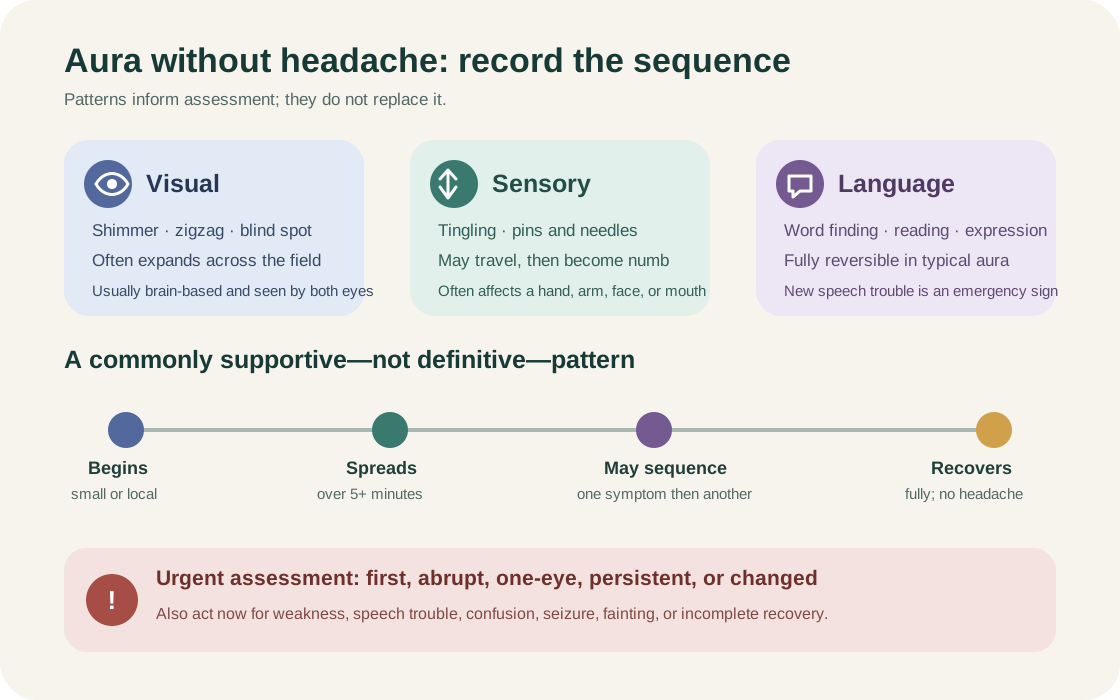
| Aura domain | Examples people may report |
|---|---|
| Visual | Shimmering spot, zigzag or jagged line, flashes, a spreading blind spot, distorted edges, or a missing area in the visual field |
| Sensory | Pins and needles that travel from a hand toward an arm or face, followed by temporary numbness |
| Speech/language | Trouble finding words, reading, producing language, or understanding words despite being awake |
These symptoms should be fully reversible in typical aura. They often evolve over minutes rather than appearing at full intensity at once. One symptom may follow another, so the complete episode can last longer than any single symptom.
What visual aura without headache can look like
Visual aura is the most common aura domain. A small blurred or shimmering area may appear near the center of vision, expand outward, develop a bright jagged edge, and leave a temporary blind area behind it. Other people see flickering dots, geometric shapes, heat-wave distortion, or a broken arc.
Brain-based visual aura generally affects the same region of the visual field in both eyes, although it can feel as if it is in one eye. If it is safe, covering one eye and then the other can help record whether the pattern remains visible with either eye. Do not use that check to delay urgent care, and never perform it while driving.
Darkness or light sensitivity without a spreading neurological visual pattern is not automatically aura. Read photophobia and light sensitivity for that distinction and ocular migraine terminology for the difference between visual-field aura and one-eye symptoms.
Sensory and speech aura without pain
Sensory aura often begins as a positive symptom—tingling or pins and needles—and may spread gradually along one hand, arm, face, tongue, or mouth. Numbness can follow. A static numb patch that starts suddenly is less typical and should not be self-labeled as migraine.
Speech/language aura can affect naming, word production, reading, or comprehension. It is not the same as simply feeling foggy or distracted. Because new speech difficulty is also a stroke warning sign, a first episode should be treated as urgent rather than tested at home.
Typical aura does not include motor weakness. Weakness can occur in hemiplegic migraine, but that rare diagnosis is made only after urgent vascular causes have been assessed. Similarly, double vision, fainting, reduced consciousness, marked unsteadiness, or symptoms confined to one eye are not ordinary typical-aura features.
The usual silent migraine timeline
ICHD-3’s broader migraine-with-aura criteria describe recurrent, fully reversible neurological symptoms. Features that support aura include gradual spread over at least five minutes, two or more symptoms occurring in sequence, a positive symptom such as flashing or tingling, and an individual symptom lasting 5–60 minutes. Not every attack displays every feature.
A possible sequence might be:
- A small shimmering point appears.
- The shape enlarges or moves over 10–20 minutes.
- Tingling begins in one hand as the visual effect fades.
- All neurological symptoms resolve.
- No headache occurs during the event or in the following hour.
That is an illustration, not a diagnostic template. Aura can depart from textbook descriptions, and ischemic events can sometimes progress or include positive symptoms too. Timing helps a clinician reason; it does not safely rule stroke in or out.
Silent migraine vs. TIA or stroke
Migraine aura often develops gradually, includes positive symptoms, and moves from one symptom or location to another. TIA or stroke often begins suddenly and causes a loss of function such as missing vision, numbness, weakness, or language loss. Those are useful clinical tendencies—not a home test.
Research shows substantial overlap between aura and ischemic events. Stroke can have progressive or positive symptoms, while aura can feel abrupt or mainly negative. The distinction becomes harder when aura occurs without the familiar headache that previously helped identify an attack.
Emergency assessment is particularly important for:
- a first-ever visual or neurological event;
- a sudden maximal onset rather than gradual development;
- new weakness, facial droop, confusion, fainting, or seizure;
- symptoms that do not fully resolve;
- a major change in an established pattern;
- first aura-like symptoms after age 40; or
- an event during pregnancy/postpartum or with important vascular risk factors.
Do not take aspirin to “test” or treat an undiagnosed event unless an emergency clinician directs it. Some causes of neurological symptoms involve bleeding, and aspirin also has contraindications.
Silent migraine vs. retinal or eye problems
Temporary vision change in one eye needs prompt eye or medical assessment. Retinal ischemia, retinal tear or detachment, optic-nerve disease, and other eye conditions can threaten vision. Retinal migraine is rare and is a diagnosis of exclusion—not a synonym for any visual aura.
Useful details include whether the symptom persisted when either eye was covered, whether it was bright/positive or dark/missing, whether flashes or new floaters occurred, and whether there was eye pain or redness. But uncertainty about which eye was affected is normal; it should prompt evaluation, not self-reassurance.
Silent migraine vs. seizure
Focal seizures can cause visual, sensory, language, or awareness changes. Visual seizure symptoms are often very brief and stereotyped, but duration and appearance overlap with aura. Repetitive jerking, loss of awareness, an unexplained gap in memory, collapse, or a post-event confused state warrants urgent assessment.
A clinician may consider seizure more strongly when events are extremely brief, nearly identical every time, associated with altered awareness, or supported by other history. An electroencephalogram is not routinely required for ordinary migraine aura but may be used when seizure is a realistic alternative.
How silent migraine is diagnosed
There is no blood test or scan that proves typical aura without headache. Diagnosis begins with a detailed history and neurological examination. A clinician will ask about the exact symptom, how it began and spread, duration, sequence, recovery, later headache, age at onset, medications, contraception, pregnancy context, vascular risks, seizures, and family history.
The pattern usually needs at least two qualifying attacks for a definite ICHD-3 migraine-with-aura diagnosis. A first episode can be evaluated as a possible or probable migraine pattern only after appropriate alternatives are considered.
Testing is individualized. A brain MRI or other imaging may be used for a first, late-onset, prolonged, persistent, or otherwise atypical event. An eye examination helps when symptoms may be monocular. Vascular or seizure testing depends on the presentation. Normal imaging does not itself prove migraine; it helps address selected alternatives.
What to do during an established aura-without-headache episode
If a clinician has already diagnosed your recurring pattern and given you a plan:
- Stop driving, cycling, cooking over heat, climbing, or using machinery.
- Sit or lie somewhere safe with lower glare and visual demand.
- Note the start time and describe the first symptom before memory blurs.
- Record how it spreads, whether another symptom follows, and when each resolves.
- Follow the agreed rescue plan for associated nausea, light sensitivity, or later headache.
- Escalate if the event differs from the plan’s boundaries or does not resolve as expected.
Closing the eyes may make an aura easier to tolerate but does not end the neurological process. Hydration and a regular meal can support general migraine care, yet neither is a substitute for evaluating a new neurological symptom.
Silent migraine treatment
Aura often resolves before an oral medicine can take effect, and evidence for treating aura without headache is limited. There is no single FDA-approved medicine specifically for aura-only attacks. That is why treatment is individualized rather than copied from a standard headache rescue plan.
For occasional, brief, established aura, the practical plan may focus on safety, reducing visual demand, and treating associated nausea or a later headache if it occurs. Frequent, prolonged, or disabling attacks may lead a clinician to consider migraine-preventive treatment. Small studies and clinical experience exist for several medicines, but the evidence is much thinner than for migraine headache prevention.
Do not begin daily aspirin, magnesium, a calcium-channel blocker, lamotrigine, or another off-label treatment from an online list. The potential benefit, dose, interactions, bleeding or pregnancy risk, and alternative diagnosis all require individual review.
Prevention and vascular-health context
Regular sleep, meals, hydration, physical activity, and a consistent caffeine pattern can reduce overall migraine instability for some people. Track possible factors before imposing broad food or activity restrictions; an aura that followed something once does not prove causation.
Migraine with aura is associated with a higher relative ischemic-stroke risk, although the absolute risk for an individual may remain low. Smoking cessation and management of blood pressure, cholesterol, diabetes, and other vascular risks are useful health priorities.
Contraception deserves a specific conversation. The CDC’s 2024 U.S. Medical Eligibility Criteria classifies combined hormonal contraception as category 4—an unacceptable health risk—for people with migraine with aura. Other contraceptive categories differ. Do not stop contraception without a replacement plan; discuss the aura history promptly with the prescribing clinician.
A high-value aura record
For each event, capture:
- exact visual, sensory, or language symptom in your own words;
- start time, sudden versus gradual onset, and direction of spread;
- one eye, both eyes/same visual field, one body side, or uncertain;
- positive features (flashing, zigzag, tingling) and negative features (missing vision, numbness);
- start and stop time of each symptom;
- complete or incomplete recovery;
- headache or other migraine symptoms during the next 60 minutes;
- medicine used and response; and
- whether the event was first, typical, or changed.
If safe, sketch the visual shape and direction of movement. A contemporaneous record is more useful than a later label such as “ocular migraine.” Read the broader migraine aura guide for a detailed observation framework.
Frequently asked questions
Can you have a migraine without a headache?
Yes. Typical aura without headache is a recognized ICHD-3 diagnosis. People can also experience migraine-associated nausea, light sensitivity, fatigue, or dizziness with little or no pain, but those symptoms alone do not establish aura.
How long does a silent migraine last?
Each typical aura symptom usually lasts 5–60 minutes, and symptoms can occur one after another. The full event can therefore last longer than one individual symptom. A first, unusually brief, prolonged, or persistent episode needs assessment.
Can silent migraine cause vision loss?
Aura can create a temporary missing area in the visual field, usually affecting corresponding vision in both eyes. New true loss of vision—especially in one eye—needs urgent assessment because eye and vascular disorders can look similar.
Is silent migraine dangerous?
An established typical aura usually resolves completely, but the same symptoms can signal urgent disease, and migraine with aura carries vascular-health considerations. The danger is assuming a first or changed neurological event is “just migraine.”
Can silent migraine be treated?
Yes, but aura-only evidence is limited. Treatment may emphasize episode safety, associated-symptom relief, management of any later headache, and prevention when attacks are frequent or disabling. A clinician should tailor the plan after confirming the diagnosis.
The practical takeaway
Silent migraine is better called migraine aura without headache or typical aura without headache. It usually involves fully reversible visual, sensory, or speech/language symptoms that develop over minutes and are not followed by head pain. Record the sequence and recovery, stop unsafe activities, and use a clinician-agreed plan for established attacks. Treat a first, abrupt, one-eye, persistent, or substantially changed event as a medical problem to assess—not a migraine label to assume.
For terminology context, explore types of migraine, migraine aura, and the medical disclaimer.
Sources
- Typical aura without headacheInternational Headache Society · Accessed
- Migraine with auraInternational Headache Society · Accessed
- Migraine with typical auraInternational Headache Society · Accessed
- Aura without headache or “silent migraine”: A guideAmerican Migraine Foundation · Accessed
- Migraine with aura—Symptoms and causesMayo Clinic · Accessed
- Migraine with aura—Diagnosis and treatmentMayo Clinic · Accessed
- Visual phenomena associated with migraine and their differential diagnosisDeutsches Ärzteblatt International / PubMed Central · Accessed
- U.S. Medical Eligibility Criteria for Contraceptive Use, 2024—Summary classificationsCenters for Disease Control and Prevention · Accessed