
Vestibular migraine causes repeated episodes of vertigo, motion-triggered dizziness, or imbalance. Headache may happen before, during, or after the dizziness. It may also be absent. The consensus criteria look for a repeated pattern, a history of migraine, migraine features during at least half of qualifying episodes, and no better explanation.
The sensation may feel like spinning, rocking, tilting, swaying, or motion sickness. Head movement or a visually busy place may bring it on. Episodes can last minutes, hours, or sometimes days. Stroke, inner-ear disease, positional vertigo, and medication effects can look similar, so a first or substantially changed attack needs assessment.
Call emergency services for sudden dizziness or loss of balance with weakness, numbness, facial droop, speech or vision change, confusion, inability to stand or walk, fainting, or a sudden severe headache. Sudden hearing loss, persistent vomiting, serious injury, or a first severe continuous vertigo episode also needs prompt evaluation.
What vestibular migraine feels like
“Dizzy” can mean several different experiences. Vestibular migraine may involve:
- spontaneous vertigo: the self or surroundings seem to spin or move without an obvious trigger;
- positional vertigo: symptoms begin after a change in head position;
- visually induced vertigo: movement in a supermarket aisle, crowd, traffic scene, scrolling screen, or movie creates a false sense of motion;
- head-motion vertigo: turning, bending, or looking up creates movement sensations; or
- head-motion dizziness with nausea: movement produces spatial disorientation and queasiness even without classic spinning.
People may also report rocking, floating, tilting, swaying, unsteadiness, motion sensitivity, nausea, or difficulty walking in a straight line. General lightheadedness or a near-faint feeling is less specific and can point toward blood-pressure, cardiac, metabolic, medication, anxiety, or dehydration contexts.
The two-track vestibular migraine pattern
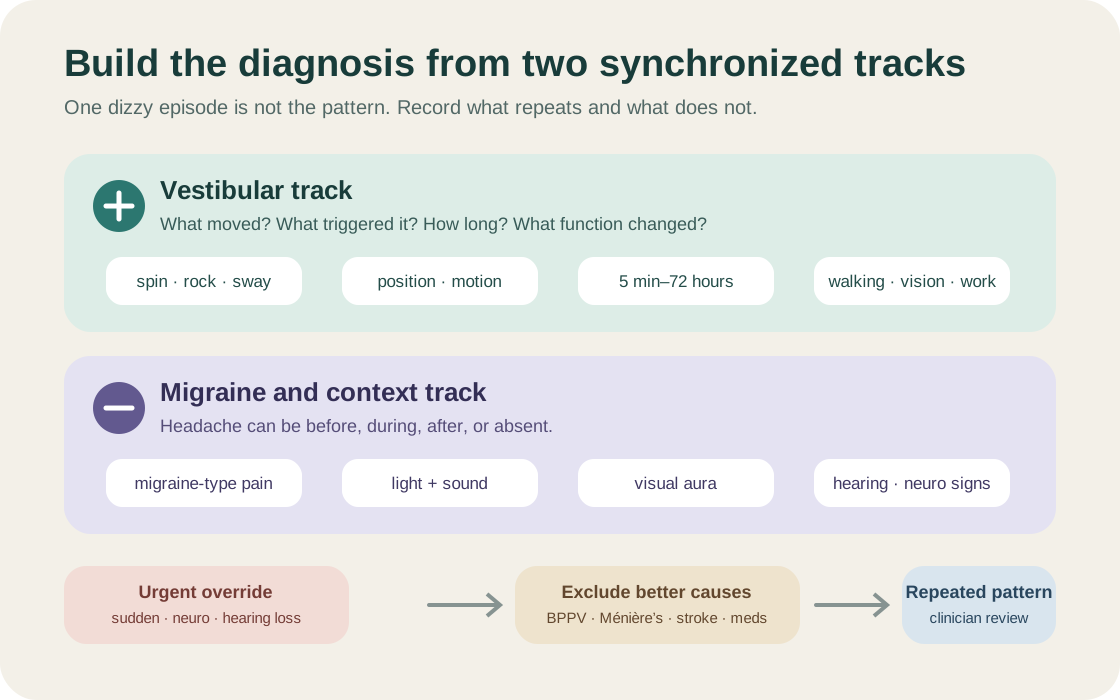
Track vestibular symptoms and migraine features separately, then align their times. Headache may begin before, during, after, or not at all. Light and sound sensitivity, visual aura, or migraine-type headache can supply the migraine association even when pain is not the main complaint.
One episode is rarely enough to establish the diagnosis. The formal pattern requires at least five qualifying vestibular episodes, and at least half must include a defined migraine feature.
Vestibular migraine diagnostic criteria
The Bárány Society and International Headache Society consensus criteria require all of the following for definite vestibular migraine:
- At least five episodes with moderate or severe qualifying vestibular symptoms.
- Each episode lasts between 5 minutes and 72 hours.
- The person has a current or past diagnosis of migraine with or without aura.
- At least half of vestibular episodes include migraine-type headache, both photophobia and phonophobia, or visual aura.
- Another vestibular disorder or headache diagnosis does not explain the pattern better.
The migraine-type headache feature itself requires at least two of four characteristics: one-sided location, pulsating quality, moderate or severe intensity, or aggravation by routine physical activity.
These are clinician-applied criteria, not a quiz. The consensus emphasizes that migraine symptoms during vertigo do not prove vestibular migraine, because migraine features can be triggered by or coexist with other vestibular disorders.
How long vestibular migraine lasts
The required episode window is broad: 5 minutes to 72 hours. The consensus describes substantial variation:
- some people have episodes lasting minutes;
- many have attacks lasting hours;
- some experience symptoms over several days; and
- some have brief repeated attacks triggered by head motion, visual stimulation, or position, with the total recurring period used for duration.
Recovery can take longer than the core attack. The criteria note that some people may need weeks to recover fully after an episode, although the core rarely exceeds 72 hours. Persistent daily dizziness should not simply be stretched into one continuous vestibular migraine attack; clinicians may consider incomplete recovery, frequent attacks, persistent postural-perceptual dizziness (PPPD), medication effects, or another balance disorder.
Headache may be absent
Vestibular migraine is not “a migraine headache that makes you dizzy.” Johns Hopkins notes that headache and vestibular symptoms frequently do not happen at the same time. Some episodes may feature motion sensitivity, nausea, light and sound sensitivity, or visual aura without head pain.
This explains why the diagnosis can be missed in someone whose severe headaches occurred years earlier. A lifetime migraine history still matters. Conversely, dizziness plus an ordinary headache does not automatically meet the criteria; the episode relationship, qualifying features, and exclusions still apply.
Vestibular migraine vs. BPPV
Benign paroxysmal positional vertigo (BPPV) commonly causes brief, repeated spinning after a specific head movement, such as rolling over in bed, looking up, or bending. Johns Hopkins describes a classic pattern in which symptoms occur only with a particular position and last less than a minute once the head remains still, without neurological symptoms or hearing loss.
Vestibular migraine can also be positional, so duration and trigger alone may not settle the difference. Eye-movement findings during an examination, repeated attack history, migraine features, and response to a correctly performed repositioning maneuver help clinicians differentiate them. The two conditions can coexist.
Do not repeatedly provoke severe symptoms or perform an online maneuver after a first unexplained episode, with neck/back limitations, or when neurological symptoms are present. A clinician or vestibular therapist can first establish whether the pattern fits BPPV and which side/canal is involved.
Vestibular migraine vs. Ménière’s disease
Both conditions can cause episodic vertigo, nausea, imbalance, tinnitus, and ear fullness. Hearing is an important discriminator.
NIDCD describes definite Ménière’s disease as recurrent spontaneous vertigo lasting 20 minutes to 12 hours, hearing-test-confirmed low- to mid-frequency hearing loss, fluctuating symptoms such as tinnitus or fullness in the affected ear, and no better balance diagnosis. Johns Hopkins notes that subjective ringing, pressure, or fullness can occur in vestibular migraine, but significant hearing loss should increase suspicion for an inner-ear disorder.
An audiogram can document whether hearing changes and how. Migraine and Ménière’s can coexist, so the choice is not always binary. Sudden hearing loss is time-sensitive and needs urgent assessment rather than a diary-first approach.
Vestibular migraine vs. stroke
Posterior-circulation stroke can present with sudden continuous vertigo, imbalance, nausea, and abnormal eye movements, sometimes without obvious one-sided weakness. The CDC lists sudden trouble walking, dizziness, loss of balance, vision change, weakness/numbness, confusion or speech trouble, and sudden severe headache as stroke warning signs.
Seek emergency help for a first sudden severe episode, especially with:
- inability to stand or walk without support;
- double vision or new loss of vision;
- facial droop, one-sided weakness, or numbness;
- slurred speech, language difficulty, confusion, or fainting;
- a new severe headache or neck pain; or
- major vascular risk, recent neck injury, pregnancy/postpartum, or a clearly different pattern.
Symptoms that improve can still represent TIA. A normal-looking face or history of migraine cannot rule out stroke. Bedside eye-movement testing for acute vestibular syndrome requires trained interpretation and is not a home test.
Other causes of dizziness and vertigo
Assessment may also consider vestibular neuritis or labyrinthitis, PPPD, concussion, medication adverse effects or withdrawal, orthostatic hypotension, arrhythmia, anemia, glucose problems, anxiety/panic, dehydration, ear infection, superior canal dehiscence, and less common neurological disorders.
The timing-and-triggers framework is useful:
| Pattern | Examples clinicians may consider |
|---|---|
| Seconds with a position change | BPPV, orthostatic blood-pressure change |
| Minutes to hours in attacks | Vestibular migraine, Ménière’s disease, TIA |
| Continuous for hours to days | Vestibular neuritis, labyrinthitis, stroke, prolonged vestibular migraine |
| Persistent most days, worse upright or with visual motion | PPPD, incomplete vestibular compensation, frequent migraine-related symptoms |
This table organizes a history; it is not a diagnostic shortcut.
What to do during an established attack
If the pattern has already been assessed as vestibular migraine and the current episode is typical:
- Stop driving, using stairs alone, swimming, or operating machinery.
- Sit or lie somewhere safe with support available.
- Reduce visually busy input, glare, and head movement if they worsen symptoms.
- Follow the acute treatment plan agreed with your clinician.
- Sip fluids if safe and tolerated; do not force food or fluid during repeated vomiting.
- Record onset, vestibular sensation, migraine features, medicine timing, and recovery.
Escalate for new neurological or hearing symptoms, injury, inability to keep fluids down, a major change from the usual pattern, or failure to return toward baseline. Avoid driving as soon as the spinning stops if balance, visual focus, reaction time, or medication drowsiness remains impaired.
How vestibular migraine is diagnosed
There is no single blood test, scan, hearing test, or vestibular test that confirms vestibular migraine. Diagnosis is clinical and exclusionary.
A clinician may review the episode pattern, lifetime migraine history, hearing symptoms, medicines, cardiovascular factors, and neurological symptoms; examine eye movements, gait, balance, ears, and nervous-system function; and arrange audiometry, vestibular testing, imaging, or blood tests when the pattern requires them.
The appropriate clinician depends on the presentation. Primary care can begin the evaluation. Neurology or a headache specialist may manage migraine-dominant patterns. ENT/neurotology and audiology are particularly useful when hearing change, tinnitus, ear pressure, or a peripheral vestibular disorder is suspected. Vestibular physical therapy can assess function and rehabilitation needs after urgent causes and BPPV have been addressed.
Vestibular migraine treatment
Treatment usually combines attack management, prevention, and rehabilitation based on the dominant disability. A 2022 practical review found that evidence specific to vestibular migraine remains limited; many choices are borrowed from standard migraine care rather than supported by large vestibular-migraine trials.
An individualized plan may include:
- acute headache treatment: appropriate nonprescription medicine or a migraine-specific prescription;
- nausea or short-term vertigo treatment: selected anti-nausea or vestibular-suppressing medicine, with attention to sedation and limits on repeated use;
- prevention: a migraine preventive chosen around attack frequency, blood pressure, sleep, mood, weight, pregnancy possibility, and other conditions;
- vestibular rehabilitation: graded gaze, balance, walking, and motion work for persistent imbalance or avoidance; and
- regularity measures: consistent sleep, meals, hydration, movement, and stress management without an unnecessarily restrictive trigger diet.
The Cochrane review of acute medicines found very limited and uncertain evidence for triptans’ effect on vertigo symptoms. That does not mean no treatment can help; it means response varies and the evidence cannot support a universal “best” drug. A clinician should also review medication-overuse risk, sedating combinations, and whether frequent vestibular suppressants could slow compensation.
Vestibular rehabilitation and visual-motion sensitivity
Vestibular rehabilitation is not simply “practice being dizzy.” A trained therapist chooses exercises after assessing gaze stability, balance, walking, motion sensitivity, neck or musculoskeletal constraints, and fall risk. Exercises are progressed so that symptoms are challenged without causing repeated severe crashes.
It may be particularly useful when imbalance persists between attacks, visual motion causes avoidance, confidence in walking has fallen, or vestibular migraine coexists with PPPD or another compensated vestibular injury. It does not replace migraine prevention or treatment of BPPV, Ménière’s disease, stroke, or sudden hearing loss.
Track two synchronized symptom streams
Use one row per episode and keep the vestibular and migraine streams distinct:
| Vestibular stream | Migraine and context stream |
|---|---|
| Spinning, rocking, swaying, imbalance, or head-motion dizziness | Headache location, quality, severity, and activity effect |
| Exact start/end; continuous or repeated bursts | Light and sound sensitivity, visual aura, nausea |
| Spontaneous, positional, head-motion, visual-motion, or standing trigger | Sleep, meals, menstrual timing, stress, illness, medicine changes |
| Walking, reading, screens, work, and driving affected | Acute medicine time, benefit, adverse effects, return to baseline |
| Hearing change, tinnitus, ear fullness, pain | Neurological symptoms and urgent assessment received |
Add counterexamples: an episode with vertigo but no migraine feature, a migraine headache without dizziness, or positional spinning that resolved after assessed BPPV treatment. Those details help prevent every symptom from being forced into one diagnosis. The possible-factor guide explains how to test repeated associations without over-restricting daily life.
Frequently asked questions
Can vestibular migraine occur without headache?
Yes. Headache does not need to occur during every vestibular episode. The diagnostic pattern can be supported by visual aura or simultaneous light and sound sensitivity, provided the other criteria are met and a better explanation is excluded.
Is vestibular migraine the same as migraine with brainstem aura?
No. Migraine with brainstem aura requires a specific combination of fully reversible brainstem symptoms in an aura time pattern. Most vestibular migraine attacks do not meet those criteria. Read the migraine types guide for the formal distinction.
Can vestibular migraine cause hearing loss?
Tinnitus, pressure, and subjective hearing symptoms can occur, but significant or progressive hearing loss raises concern for an inner-ear disorder such as Ménière’s disease. Sudden hearing loss needs urgent assessment.
Is vestibular migraine permanent?
The disorder can be recurrent, and some people have lingering motion sensitivity or imbalance between attacks. Symptoms are not necessarily permanent, but persistent daily dizziness needs reassessment for frequent migraine activity, PPPD, incomplete vestibular compensation, medicine effects, or another diagnosis.
What is the best treatment for vestibular migraine?
There is no proven single best treatment. The plan is usually selected from migraine acute/preventive care, nausea or limited vertigo control, vestibular rehabilitation, and regular routines. Evidence specific to vestibular symptoms remains limited, so comorbidities, side effects, disability, and individual response guide selection.
The practical takeaway
Vestibular migraine is a repeated, criteria-based relationship between qualifying vestibular episodes and migraine—not a synonym for unexplained dizziness. Record the sensation, trigger, duration, hearing changes, neurological symptoms, and migraine features on two synchronized tracks. Seek urgent care for sudden, severe, neurologically accompanied, hearing-loss, or substantially changed episodes; then work with the appropriate clinician on diagnosis-specific acute treatment, prevention, and rehabilitation.
For related patterns, see migraine aura, photophobia and light sensitivity, and the medical disclaimer.
Sources
- Vestibular migraine—Diagnostic criteria updateJournal of Vestibular Research / PubMed Central · Accessed
- Vestibular migraineInternational Headache Society · Accessed
- Vestibular migraineJohns Hopkins Medicine · Accessed
- If you are experiencing dizzinessJohns Hopkins Medicine · Accessed
- Vestibular migraine treatment—A comprehensive practical reviewBrain / PubMed Central · Accessed
- Pharmacological interventions for acute attacks of vestibular migraineCochrane Database of Systematic Reviews / PubMed Central · Accessed
- What Is Ménière’s Disease?National Institute on Deafness and Other Communication Disorders · Accessed
- Signs and Symptoms of StrokeCenters for Disease Control and Prevention · Accessed