
An occipital headache is pain at the back of the head, upper neck, or base of the skull. The location alone does not reveal the cause. Migraine, tension-type headache, pain referred from the neck, and occipital neuralgia can all hurt there. Useful clues include whether the pain is steady or shock-like, lasts seconds or hours, changes with neck movement, or comes with migraine symptoms or scalp tenderness.
Occipital neuralgia is a specific nerve-pain disorder. It tends to cause brief shooting, stabbing, or electric attacks from the upper neck or skull base over the scalp. Migraine pain at the back of the head usually lasts longer and may include nausea, light or sound sensitivity, or difficulty with activity. A cervicogenic headache is referred from a neck disorder; a sore neck or abnormal scan alone is not enough to prove that link.
Seek emergency help for a thunderclap headache or back-of-head/neck pain with new weakness, numbness, speech or balance trouble, fainting, confusion, seizure, sudden vision change, fever with marked neck stiffness, or significant recent head/neck injury. Sudden unusual one-sided neck and head pain with neurological or pupil/eyelid changes also needs emergency assessment.
Occipital headache patterns at a glance
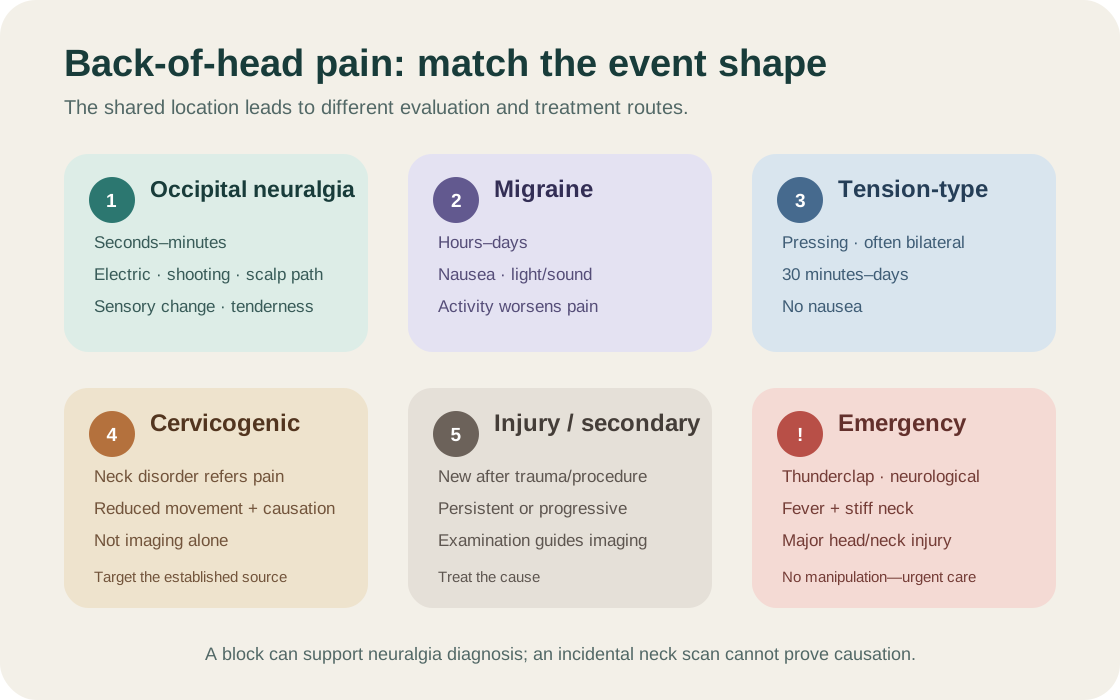
| Pattern | Pain quality and duration | Other useful clues |
|---|---|---|
| Occipital neuralgia | Seconds-to-minutes shooting, stabbing, electric pain; possible background ache | Follows one or both occipital nerves; scalp sensitivity/numbness; tenderness on examination |
| Migraine | Hours-to-days throbbing, pressure, or ache | Nausea, light/sound sensitivity, worse with activity, possible aura |
| Tension-type headache | Pressing/tightening for 30 minutes to days | Often bilateral; mild/moderate; not worsened by routine activity; no nausea |
| Cervicogenic headache | Usually one-sided, often begins in neck/back of head and refers forward | Reduced neck range, provocation by a neck disorder, and evidence of causation |
| Post-traumatic or structural pain | Variable, new after injury or procedure | Neck tenderness, restricted movement, concussion or neurological symptoms |
More than one pattern can coexist. Migraine frequently includes neck pain, and a person with migraine can separately develop occipital neuralgia or a cervical disorder.
Occipital neuralgia symptoms
ICHD-3 defines occipital neuralgia as unilateral or bilateral paroxysmal shooting or stabbing pain in the posterior scalp distribution of the greater, lesser, or third occipital nerves. Attacks last seconds to minutes and are severe, sharp, or stabbing.
At least some of the following typically accompany the pain:
- unpleasant altered sensation or reduced sensation in the affected scalp;
- marked sensitivity to light touch, hair brushing, a hat, or a pillow;
- tenderness over the affected nerve on examination; or
- a trigger point near the nerve’s emergence or in the upper neck.
Pain can travel upward over the scalp and forward toward the eye because upper-cervical and trigeminal pain pathways converge. This does not mean the eye itself is diseased, but new vision change or a painful red eye still requires eye assessment.
Where the occipital nerves run
The greater occipital nerve supplies much of the back and top of the scalp. The lesser occipital nerve supplies the scalp behind and above the ear, while the third occipital nerve supplies a smaller lower-occipital area.
Occipital neuralgia usually follows one of these pathways rather than producing a uniform helmet of pressure. The path can be one-sided or bilateral. A brief electric line from the base of the skull upward is more suggestive than vague continuous neck tightness, but examination remains essential.
Do not repeatedly press the presumed nerve or force neck positions to reproduce pain. Self-provoked tenderness is not equivalent to the clinical findings in the diagnostic criteria.
Occipital neuralgia vs. migraine
Migraine can begin in the upper neck or back of the head and move forward. It can also make the scalp tender and ordinary touch painful, which overlaps with neuralgia.
The event shape helps:
- Occipital neuralgia: seconds-to-minutes electric or stabbing paroxysms along a posterior scalp path, sometimes on top of a background ache.
- Migraine: a sustained attack lasting hours to days with nausea, light/sound sensitivity, activity worsening, and possible aura.
A momentary jab during a longer migraine does not automatically create two diagnoses. Conversely, treating every scalp shock as migraine can miss a neuralgia. Track the short shocks and the sustained headache as separate time streams, then note where they overlap.
Occipital neuralgia vs. cervicogenic headache
Cervicogenic headache is pain referred from a disorder of the neck. ICHD-3 requires clinical or imaging evidence of a cervical lesion or disorder capable of causing headache plus evidence of causation—for example, the headache developed with the neck disorder, improved as it improved, is reduced by a diagnostic block, or is provoked with reduced cervical range of motion.
Occipital neuralgia is neuropathic pain in the occipital nerves. Cervicogenic headache is nociceptive referred pain from cervical structures. Both may start near the skull base and travel forward, but the pain quality and examination differ.
Common age-related changes on an X-ray or MRI do not prove the neck is causing the headache. Similarly, temporary improvement after massage does not establish a cervical diagnosis.
Occipital headache vs. tension-type headache
Tension-type headache often creates bilateral pressure or tightening across the back of the head, temples, or forehead. The pain usually builds and lasts much longer than an occipital-neuralgia shock. Routine movement does not worsen it, and nausea is absent.
Neck and pericranial tenderness can accompany tension-type headache, but it is not simply a “tight muscle headache.” The tension headache guide explains frequency categories and acute/preventive treatment in depth.
Causes of occipital neuralgia
Occipital nerve irritation may follow:
- head or neck injury, including whiplash;
- prior scalp, skull, or upper-neck surgery;
- compression or irritation near the upper cervical roots or where the nerve crosses muscles/fascia;
- arthritis or another structural upper-neck disorder;
- inflammation, infection such as shingles, diabetes-related neuropathy, or a mass—less commonly; or
- no identifiable cause.
The phrase “tight neck muscles pinched the nerve” is often presented too confidently online. Muscle and fascial compression may contribute, but persistent neuralgia can have several explanations and sometimes remains idiopathic after assessment.
Other causes of pain at the back of the head
Back-of-head pain may also occur with migraine, tension-type headache, medication overuse, viral illness, sleep disruption, high exertion, coughing/straining, low cerebrospinal-fluid pressure, increased intracranial pressure, blood-vessel disorders, infection, or injury.
A new continuous occipital headache is not the same as seconds-long neuralgia. A sudden severe onset, major positional pattern, exertional trigger, fever, persistent vomiting, neurological symptoms, or recent procedure changes the evaluation.
When back-of-head pain is urgent
Call emergency services for:
- a headache that reaches maximum severity within a minute;
- new weakness, numbness, facial droop, speech/language difficulty, severe imbalance, confusion, seizure, or fainting;
- sudden double vision, vision loss, unequal pupil, or drooping eyelid;
- fever with severe headache and marked neck stiffness;
- severe pain after significant head or neck injury; or
- sudden unusual one-sided neck/head pain after forceful neck movement, manipulation, or trauma.
Seek prompt medical review for a new progressively worsening pattern, persistent neurological symptoms, pain triggered by cough/exertion/straining, a major positional headache, cancer or immune suppression, pregnancy/postpartum context, or onset after age 50.
Do not perform high-velocity neck manipulation or forceful stretching on a new unexplained occipital headache.
How occipital headache is diagnosed
The clinician will separate brief paroxysms from sustained headache, map the pain path, review migraine features and injuries, and examine the scalp, occipital nerves, neck movement, strength, sensation, reflexes, balance, pupils, and other neurological functions.
For suspected occipital neuralgia, ICHD-3 includes temporary relief from a local anesthetic block of the affected nerve. A block can support the diagnosis but is not perfectly specific; other headaches may also improve after occipital nerve injection.
Imaging is selected when history or examination suggests a cervical, structural, vascular, inflammatory, or secondary cause. It is not automatically required for every classic stable neuralgia pattern, and incidental neck findings should be interpreted in context.
Occipital headache treatment
Treatment depends on whether the diagnosis is neuralgia, migraine, tension-type headache, cervicogenic headache, or another cause.
Conservative care
For an assessed musculoskeletal or neuralgia pattern, a clinician may recommend short-term heat or cold, posture and workstation changes, physical therapy, and gradual neck/shoulder conditioning. Therapy should be tailored to range of motion, nerve irritability, injury history, and whether movement provokes dizziness or neurological symptoms.
Medicines
Options may include appropriate nonprescription pain relief for a short flare or prescription medicines used for neuropathic pain, such as selected antiseizure or antidepressant medicines. The choice depends on sedation, mood, pregnancy possibility, kidney/liver function, cardiovascular risks, and other medicines.
Occipital nerve block
A clinician injects local anesthetic, sometimes with a corticosteroid, near an occipital nerve. The procedure may help confirm the pain source and provide temporary relief ranging from hours to longer periods. Response varies, and repeated injections carry procedural and medicine-specific risks.
Persistent cases
Specialists may consider botulinum toxin, radiofrequency procedures, peripheral nerve stimulation, or surgical decompression in carefully selected refractory cases. Evidence and risks vary; surgery is not a first-line fix for ordinary back-of-head pain.
What you can do during a familiar flare
If the pattern has already been assessed and no red flags are present:
- Stop the position or activity that is clearly aggravating pain without forcefully testing range.
- Support the head and neck in a neutral, comfortable position.
- Use the heat/cold and medicine plan previously agreed with your clinician.
- Reduce prolonged downward phone/laptop viewing and change position regularly.
- Keep movement gentle; avoid forceful manipulation, aggressive self-massage over a nerve, or sudden stretching.
- Note the short shocks separately from any sustained migraine-like background headache.
If scalp touch hurts, use a softer pillowcase, loosen tight headwear, and avoid pressure on the sensitive area while arranging follow-up. Comfort measures do not prove a nerve diagnosis.
A two-stream back-of-head record
| Nerve-like stream | Sustained-headache and context stream |
|---|---|
| Seconds/minutes; electric, shooting, stabbing | Hours/days; pressure, throbbing, ache |
| Base-of-skull start and exact scalp path | Nausea, light/sound sensitivity, activity effect |
| One/both sides; scalp numbness or light-touch pain | Neck ache, posture, sleep, illness, medicine use |
| Spontaneous or natural movement/touch association | Injury/procedure, cough/exertion, positional change |
| Number of bursts and pain-free intervals | Functional impact and return to baseline |
This prevents a five-second shock and a 12-hour migraine from being averaged into one unhelpful “all-day occipital headache.”
Frequently asked questions
Is an occipital headache the same as occipital neuralgia?
No. “Occipital headache” describes location. Occipital neuralgia is a specific seconds-to-minutes nerve-pain disorder with a characteristic posterior-scalp distribution, sensory/tenderness findings, and temporary response to nerve block.
Can occipital neuralgia cause pain behind the eye?
Yes. Connections between upper-cervical and trigeminal pain pathways can refer occipital nerve pain toward the eye. A painful red eye, vision loss, halos, or new pupil change still needs urgent eye or neurological assessment.
Does occipital neuralgia show on MRI?
Not necessarily. Imaging may reveal a cervical or structural cause, but many cases have no decisive imaging finding. Diagnosis is primarily clinical and may be supported by an occipital nerve block.
Can poor posture cause occipital headaches?
Prolonged static or forward-head positions may aggravate neck and headache symptoms, but posture alone does not diagnose occipital neuralgia or cervicogenic headache. Repeated context, examination, and response to a graded plan matter more than a single posture photo.
What type of doctor treats occipital neuralgia?
Primary care can begin the assessment. Neurology/headache medicine, pain medicine, physical medicine and rehabilitation, or a spine/neurosurgical specialist may contribute depending on the diagnosis and treatment being considered. Physical therapy is useful when a cervical or movement component is established.
The practical takeaway
Occipital headache is pain at the back of the head; occipital neuralgia is only one possible cause. Seconds-long electric or stabbing pain following a posterior scalp nerve path points toward neuralgia, while hours-long nausea/light-sensitive pain points more toward migraine and sustained neck-referred pain may require a cervicogenic evaluation. Treatment ranges from conservative movement and migraine care to neuropathic medicines, nerve blocks, and selected procedures. Sudden severe, post-traumatic, febrile, visual, or neurological patterns need urgent assessment before any neck treatment.
For short stabbing-pain comparisons, read the ice pick headache guide, and review the medical disclaimer.
Sources
- Occipital neuralgiaInternational Headache Society · Accessed
- Cervicogenic headacheInternational Headache Society · Accessed
- Occipital neuralgiaJohns Hopkins Medicine · Accessed
- Occipital neuralgiaCleveland Clinic · Accessed
- Occipital neuralgiaAmerican Association of Neurological Surgeons · Accessed
- Neuralgias of the head—Occipital neuralgiaJournal of Korean Medical Science / PubMed Central · Accessed
- Headaches in over 12s—RecommendationsNICE · Accessed