
An ice pick headache is a sudden, intense stab of head pain that usually lasts only one to a few seconds. The formal diagnosis is primary stabbing headache, also called “jabs and jolts” headache. A stab may occur once, repeat irregularly throughout the day, or arrive in a short cluster. It often strikes around the eye, forehead, or temple but can occur anywhere on the head and may move between locations.
Primary stabbing headache is usually not dangerous once a clinician has confirmed a stable pattern. It is also so brief that an ordinary painkiller taken after a stab is unlikely to help. When attacks are frequent or disabling, preventive treatment—most commonly a clinician-supervised trial of indomethacin or another selected option—may reduce them.
An ice pick headache is not the same as a thunderclap headache. Seek emergency help for a first severe headache that reaches maximum intensity within a minute and then persists, or for sudden head pain with weakness, speech difficulty, confusion, fainting, seizure, fever/stiff neck, or vision loss.
What an ice pick headache feels like
The defining experience is an abrupt, sharply localized jab that stops almost as quickly as it begins. People describe it as:
- an ice pick, needle, nail, or knife jab;
- a brief electric-looking “jolt” inside the head;
- one stab or a short burst of several stabs;
- pain intense enough to make the person flinch or stop mid-sentence; and
- complete or near-complete relief between stabs.
ICHD-3 describes spontaneous localized stabs lasting up to a few seconds and recurring at irregular frequency from one to many per day. Longer individual stabs can occur occasionally, but pain that remains continuously severe for minutes or hours no longer fits the core ultra-brief pattern.
Ice pick headache pattern at a glance
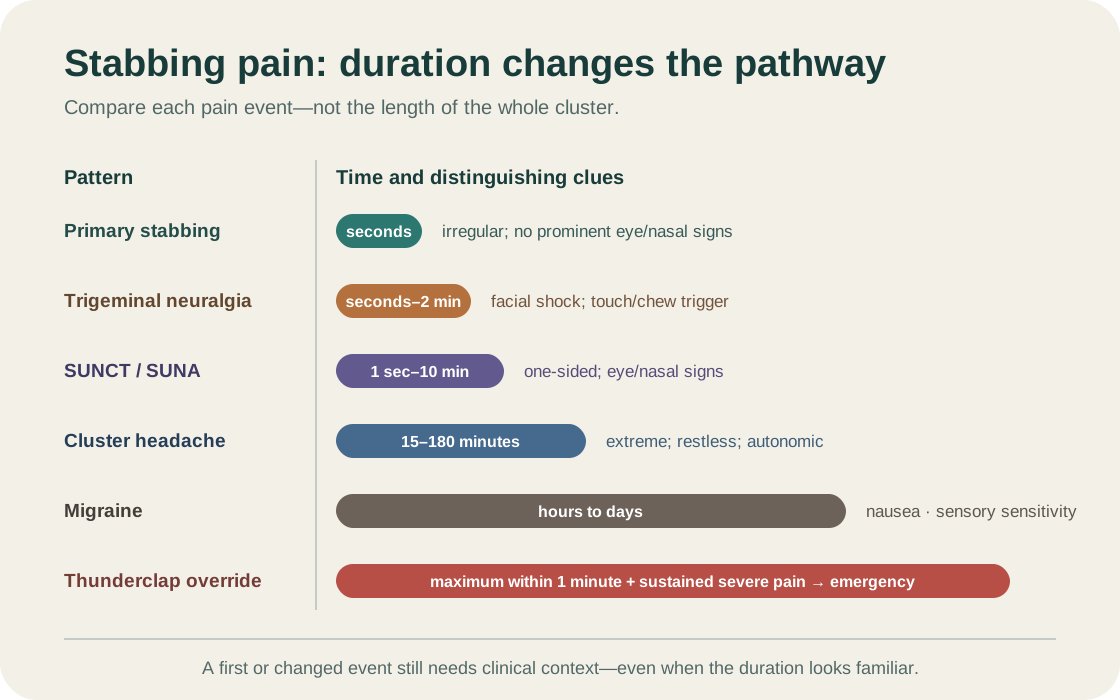
| Pattern | Usual pain duration | Clues that separate it |
|---|---|---|
| Primary stabbing headache | Usually one to a few seconds | Irregular spontaneous stabs; no prominent tearing, red eye, or nasal symptoms |
| Trigeminal neuralgia | Fraction of a second to about two minutes | Electric-shock facial pain, often triggered by touch, chewing, talking, or brushing teeth |
| SUNCT/SUNA | Seconds to minutes | Strictly one-sided orbital/temporal pain with prominent same-side tearing/redness or other autonomic signs |
| Cluster headache | 15–180 minutes | Extremely severe one-sided eye/temple pain with autonomic signs and restlessness |
| Migraine | Usually hours to days | Nausea, light/sound sensitivity, activity worsening; brief stabs may occur alongside it |
| Thunderclap headache | Reaches maximum within a minute and persists | Emergency onset pattern requiring immediate assessment |
“Stabbing” is a pain quality, not a diagnosis. The timeline and accompanying signs determine which branch needs evaluation.
Primary stabbing headache diagnostic criteria
ICHD-3 uses four elements:
- The head pain consists of a single stab or series of stabs.
- Each stab lasts up to a few seconds.
- Stabs recur at irregular frequency, from one to many per day.
- There are no cranial autonomic symptoms, and another diagnosis does not explain the pain better.
Most people do not have a perfectly countable pattern. ICHD-3 notes that up to 80% of stabs last three seconds or less, while rare attacks may last 10–120 seconds. Frequency can be low, but some people experience many stabs over several days.
These criteria organize a clinician’s assessment; they do not turn any brief sharp pain into primary stabbing headache. A new fixed-location pattern, abnormal examination, or secondary-risk context changes the workup.
Where ice pick headaches happen
Older descriptions emphasized the eye, temple, and forehead, but ICHD-3 notes that stabs commonly involve areas outside the trigeminal distribution. They can occur at the top, side, front, or back of the head.
The location often shifts between stabs. Only about one-third of people have pain fixed to one area. When every stab stays strictly in the same small spot, a clinician may investigate local structural, eye, dental, sinus, scalp, or cranial-nerve causes rather than assuming a primary disorder.
Side-switching does not prove safety, and a fixed side does not prove disease. Record the pattern without repeatedly pressing the spot to reproduce pain.
What causes ice pick headaches?
“Primary” means no other condition better explains the stabbing attacks; it does not mean the biology is fully understood. Researchers suspect very brief activation or sensitization in head-pain pathways, but there is no established single mechanism or biomarker.
Primary stabbing headache occurs more often in people who also have migraine, cluster headache, tension-type headache, or hemicrania continua. NINDS notes that the stab may occur in the same region affected by a person’s migraine. The coexistence does not make it an “ice pick migraine”; it means one person can have more than one headache phenotype.
Secondary stabbing pain can occur with eye or dental disease, shingles, infection, injury, vascular or inflammatory disease, cranial neuralgia, or a structural lesion. These are uncommon explanations overall, but they matter when the pattern is new, fixed, triggered, accompanied by abnormalities, or different from prior attacks.
Ice pick headache and migraine
Brief stabs can occur before, during, after, or between migraine attacks. A migraine background may include hours of throbbing or pressure, nausea, light and sound sensitivity, and activity intolerance, with seconds-long jabs superimposed.
Track the two separately:
- Did the stabbing cluster begin before the migraine symptoms?
- Did stabs stay in the usual migraine location?
- Were there completely pain-free intervals?
- Did the migraine treatment change the long attack, the stabs, both, or neither?
Improving migraine prevention may reduce overall headache burden, but response does not prove the stabs were part of migraine. The migraine-versus-headache guide helps separate attack phenotypes.
Ice pick headache vs. trigeminal neuralgia
Trigeminal neuralgia causes sudden electric-shock, shooting, or stabbing facial pain in the distribution of the trigeminal nerve. Attacks are commonly triggered by harmless stimuli such as touching the face, chewing, speaking, brushing teeth, washing, or a breeze.
Primary stabbing headache is usually spontaneous and centered in the head rather than consistently following a facial nerve branch. Trigger zones, facial numbness, dental-like pain without dental disease, or repeated attacks caused by ordinary touch should prompt evaluation for neuralgia or another cranial-nerve disorder.
Do not repeatedly activate a suspected trigger zone to collect evidence. Note naturally occurring triggers and stop.
Ice pick headache vs. SUNCT and SUNA
SUNCT and SUNA are short-lasting unilateral neuralgiform headache attacks. ICHD-3 describes moderate or severe, strictly one-sided orbital, supraorbital, temporal, or nearby pain lasting 1–600 seconds and occurring at least daily during active periods.
The distinguishing feature is a prominent same-side autonomic response. SUNCT includes both red eye and tearing; SUNA includes one or neither of those but another cranial autonomic sign may occur, such as nasal congestion, eyelid swelling, facial sweating, or pupil/eyelid change.
Primary stabbing headache specifically lacks these prominent autonomic features. A repeatedly red or tearing eye during short stabbing attacks deserves headache-specialist and sometimes eye evaluation rather than an ice-pick label.
Ice pick headache vs. cluster headache
Cluster attacks are much longer—15 to 180 minutes untreated—and usually cause extreme strictly one-sided pain around the eye or temple. They also produce same-side eye, nose, eyelid, pupil, or facial-sweating signs and/or marked restlessness.
Both conditions can occur in short clusters over a day, which makes the phrase “cluster of ice pick headaches” confusing. Record the duration of each pain event rather than the duration of the whole cluster. Seconds-long jabs separated by normality are different from one sustained 45-minute cluster attack.
Ice pick headache vs. thunderclap headache
The word “sudden” applies to both, but the event shapes are different:
- Primary stabbing headache: a momentary jab that generally ends within seconds.
- Thunderclap headache: severe pain reaches maximum intensity within one minute and persists as a substantial headache.
Thunderclap headache is an emergency pattern because subarachnoid hemorrhage and other vascular, pressure, infection, and pregnancy/postpartum causes must be excluded. A first severe “worst headache,” even if initially described as a stab, should be treated as thunderclap when the severe pain continues.
Call emergency services rather than driving yourself. Do not wait for nausea, weakness, or another symptom; thunderclap onset alone is enough.
Other warning signs that need assessment
Seek urgent or emergency care for stabbing head pain with:
- weakness, numbness, facial droop, speech/language difficulty, confusion, seizure, or fainting;
- sudden vision loss, double vision, a painful red eye, or new pupil/eyelid change;
- fever, stiff neck, rash, immune suppression, or severe systemic illness;
- head or neck injury;
- pregnancy or the postpartum period;
- new pain brought on by exertion, coughing, straining, or sex;
- persistent pain between stabs, steadily increasing frequency, or a major pattern change; or
- a new fixed-location series, especially after age 50 or with cancer/vascular risk.
These features do not prove a dangerous cause. They are reasons not to assume a primary stabbing disorder without evaluation.
How ice pick headache is diagnosed
There is no confirmatory scan or blood test. Diagnosis comes from the attack description, neurological and head/eye examination, and exclusion of a better explanation.
A clinician will usually ask:
- How many seconds did each stab last?
- Was there one stab, a burst, or a sustained headache?
- Did the location move or remain fixed?
- Were tearing, eye redness, nasal symptoms, or eyelid/pupil changes present?
- Did touch, chewing, movement, cough, or exertion trigger it?
- Was there an underlying migraine or other headache?
- Did any weakness, vision, fever, injury, or systemic context accompany it?
Imaging is not required for every classic stable pattern with a normal examination. It becomes more likely when symptoms are new or atypical, consistently focal, progressive, triggered, associated with neurological signs, or occurring in a higher-risk context.
Ice pick headache treatment
Treatment depends mainly on frequency and disability.
Infrequent stabs
Most individual attacks end before an acute medicine can work. Taking a painkiller after every isolated stab adds side-effect and medication-overuse risk without a realistic timing advantage. Reassurance after a sound diagnosis and observation may be all that is needed.
Frequent or disabling stabs
Indomethacin is the most frequently reported preventive treatment. Reviews describe meaningful benefit for many people, but a substantial minority do not respond. It is a prescription NSAID with gastrointestinal bleeding/ulcer, kidney, blood-pressure, cardiovascular, medicine-interaction, and pregnancy risks; it should not be borrowed, combined casually with other NSAIDs, or started without a clinician reviewing contraindications and protection/monitoring needs.
When indomethacin is unsuitable or ineffective, small studies and case reports describe other options such as melatonin, gabapentin, or selected migraine preventives. The evidence is limited, so treatment should be individualized rather than presented as a ranked universal list.
Managing a coexisting migraine, cluster headache, or neuralgia may reduce the overall burden but requires its own diagnosis-specific plan.
What to do during a burst of stabs
For a previously assessed, typical primary-stabbing pattern without red flags:
- Pause driving, tools, heights, or risky activity until the burst passes.
- Note the start time and estimate the number of stabs without watching a stopwatch continuously.
- Record whether each event fully ended and whether the location moved.
- Check for naturally occurring eye/nasal, facial-trigger, migraine, or neurological features.
- Follow the preventive plan if one was prescribed; do not repeat-dose acute painkillers for every jab.
- Escalate when the burst becomes longer, sustained, fixed, neurologically accompanied, or clearly different.
Cold or heat may feel soothing after a burst, but intentionally exposing the head to a suspected trigger or pressing the painful spot does not confirm the diagnosis.
Track micro-events without counting every jab
Exact counting becomes unrealistic when stabs are frequent. Use clusters:
| Field | Practical entry |
|---|---|
| Cluster window | “10:10–10:25” rather than 19 separate timestamps |
| Estimated frequency | 1, 2–5, 6–20, or more than 20 stabs |
| Individual duration | Momentary, 1–3 seconds, 4–10 seconds, longer/uncertain |
| Location | Fixed small spot, moving within one side, switching sides, multiple sites |
| Accompanying signs | Eye/nasal signs, facial trigger, migraine symptoms, persistent background pain |
| Function | Flinched only, stopped task, woke from sleep, unsafe to drive/work |
| Change | First event, typical, more frequent, longer, new location, incomplete recovery |
This produces a usable appointment record without turning the day into constant symptom surveillance.
Frequently asked questions
Are ice pick headaches dangerous?
Primary stabbing headache is generally benign once the pattern has been clinically assessed. New, fixed, progressive, sustained, triggered, or neurologically accompanied stabbing pain can have another cause and needs evaluation.
How long do ice pick headaches last?
Each primary-stabbing event usually lasts one to a few seconds. A burst may contain multiple stabs over minutes or hours. Continuous severe pain lasting minutes or longer does not fit the core momentary pattern and should be reassessed.
Why am I getting ice pick headaches every day?
Primary stabbing headache can recur many times daily, especially during a temporary active period, and may coexist with migraine or another headache disorder. Daily frequency is a reason to confirm the diagnosis and discuss prevention rather than repeatedly taking acute medicine.
Can stress cause ice pick headaches?
Some people notice attacks during stress, sleep disruption, or bright-light exposure, but a temporal association does not establish the cause. Track repeated patterns and counterexamples without assuming stress explains a new or changed stabbing headache.
What medicine stops ice pick headaches?
Because individual stabs end within seconds, treatment is preventive rather than abortive. Indomethacin has the most published experience but is not safe or effective for everyone. A clinician may select it or an alternative after reviewing the diagnosis, frequency, other medicines, and medical risks.
The practical takeaway
Ice pick headache usually means primary stabbing headache: spontaneous, irregular, ultra-brief jabs without prominent tearing, red eye, or nasal symptoms. The key questions are how long each stab lasts, whether pain fully stops, whether the location moves, and whether autonomic, facial-trigger, migraine, or neurological features accompany it. Infrequent confirmed stabs often need no medicine; frequent disabling attacks may justify preventive treatment. Sustained thunderclap pain or neurological/systemic warning signs require urgent care, not an ice-pick label.
For broader comparisons, read different kinds of headaches, temple headache causes, and the medical disclaimer.
Sources
- Primary stabbing headacheInternational Headache Society · Accessed
- Headache—Hope Through ResearchNational Institute of Neurological Disorders and Stroke · Accessed
- Ice pick headache (primary stabbing headache)Cleveland Clinic · Accessed
- Primary stabbing headacheJohns Hopkins Medicine · Accessed
- Short-lasting unilateral neuralgiform headache attacksInternational Headache Society · Accessed
- Ice Pick HeadacheCurrent Pain and Headache Reports / PubMed · Accessed
- Primary stabbing headache—A narrative reviewHeadache Medicine · Accessed
- Thunderclap headacheCleveland Clinic · Accessed