
A constant headache is pain that never fully goes away or feels nearly continuous. The phrase describes a pattern, not a cause. One useful clue is how it began. Did it become continuous on one clearly remembered day, or did occasional attacks slowly become more frequent?
Possible patterns include new daily persistent headache (NDPH), chronic migraine, chronic tension-type headache, and hemicrania continua. Medication overuse can occur at the same time. Pressure disorders, infection, vascular disease, eye disease, injury, and other secondary causes may also need to be ruled out. A new constant headache needs assessment even when the pain is not severe.
Get emergency help for thunderclap onset, new weakness/numbness, speech trouble, confusion, fainting, seizure, sudden persistent vision change, fever with marked neck stiffness, a painful red eye with blurred vision, or severe headache during pregnancy/postpartum.
What does “constant headache” actually mean?
People use “constant” for at least three different patterns:
- Continuous and unremitting: pain is present every moment, although intensity can rise and fall.
- Daily with gaps: pain occurs every calendar day but fully disappears for minutes or hours.
- Overlapping attacks: frequent migraine or another episodic headache creates little recovery time, so separate attacks blur together.
Those patterns are not interchangeable. A diary should record the lowest pain level and any completely pain-free interval, not only the worst flare. “Better” is not necessarily “gone.”
Why the onset timeline changes the differential
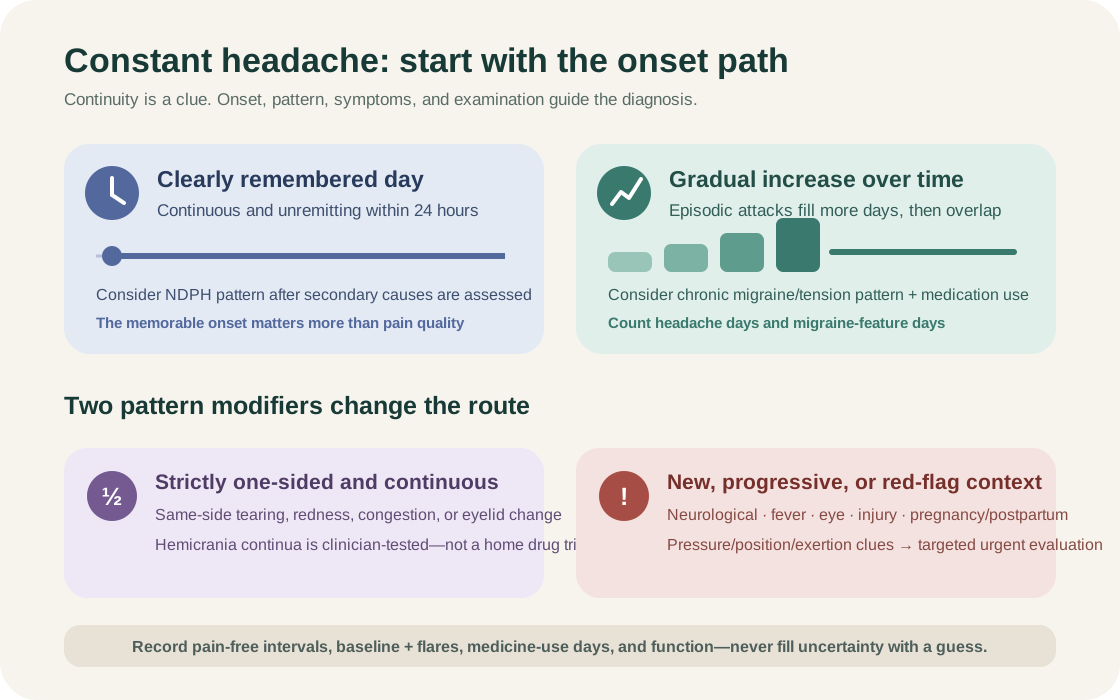
| Timeline question | Why it matters |
|---|---|
| Can you name the date or circumstances when pain began? | A clearly remembered onset that becomes unremitting within 24 hours is central to NDPH criteria |
| Did occasional migraine or tension-type headaches gradually fill more days? | Progressive frequency is more consistent with chronification than classic NDPH |
| Is the pain strictly on one side without shifting? | Continuous side-locked pain with same-side eye/nose symptoms raises hemicrania continua and secondary considerations |
| Did it begin after illness, injury, surgery/procedure, pregnancy/postpartum, or medication change? | The event may direct testing toward a secondary headache |
| Does posture, coughing/straining, exertion, or sleep reliably alter it? | These patterns can point toward pressure, structural, sleep, or vascular evaluation |
Do not provoke cough, exertion, neck movement, or positional symptoms to test the headache. Record what happens naturally.
Common primary causes of a constant headache
New daily persistent headache (NDPH)
ICHD-3 defines NDPH by a distinct, clearly remembered onset, with headache becoming continuous and unremitting within 24 hours and remaining present for more than three months. The pain can look migraine-like, tension-type-like, or mixed. A probable form can be considered earlier, but secondary causes still need assessment.
The memorable onset—not a particular pain quality—is the defining feature. If headache frequency increased gradually before becoming daily, classic NDPH is less likely. If medication overuse began only after the daily headache, NDPH and medication-overuse headache can coexist.
Chronic migraine
Chronic migraine evolves in many people from episodic migraine. It requires headache on at least 15 days per month for more than three months, with migraine features or another qualifying migraine connection on at least eight days. Pain can be continuous or fluctuate between a background headache and migraine flares.
Nausea, movement sensitivity, light/sound sensitivity, aura, and a prior episodic-migraine history support the pattern. Read the complete chronic migraine guide for calendar-day counting and current preventive options.
Chronic tension-type headache
Chronic tension-type headache also occurs on at least 15 days per month for more than three months. It usually evolves from episodic tension-type headache and tends to be bilateral, pressing/tightening, mild to moderate, and not worsened by ordinary activity. It does not have the clearly remembered, suddenly continuous onset that defines NDPH.
Migraine and tension-type features can mix when headache is frequent. ICHD-3 has rules for classification; a person should not try to choose a diagnosis from the pain adjective alone.
Hemicrania continua
Hemicrania continua is a persistent, strictly one-sided headache with exacerbations. During flares, the eye on the painful side may tear or redden, the nose may run or block, the eyelid may droop, or the person may feel restless. A complete response to prescription indomethacin is part of the formal diagnosis.
That response must be evaluated and supervised by a clinician. Indomethacin can cause gastrointestinal, kidney, cardiovascular, and other harm and is not a safe home diagnostic test. Side-locked continuous pain also requires assessment for secondary causes.
Medication overuse and constant headache
Medication-overuse headache can occur when someone with a pre-existing headache disorder has at least 15 headache days per month and regularly overuses acute headache medicine for more than three months. The medicine-day threshold depends on class: 10 days for triptans, opioids, ergotamines, combination analgesics, or mixed-class use; 15 days for simple non-opioid analgesics.
Count calendar use days and active ingredients, not tablets. Medicine used for back, dental, menstrual, or other pain can still matter. Do not abruptly stop opioids, butalbital-containing products, benzodiazepines, or other dependence-forming medicines without medical guidance. See rebound headaches for withdrawal and relapse-prevention detail.
Secondary causes doctors may consider
A secondary constant headache is attributed to another condition. The history and examination determine which possibilities deserve testing. Categories include:
- high or low cerebrospinal-fluid pressure;
- infection or systemic inflammation;
- vascular disease, including venous thrombosis or arterial disorders;
- head or neck injury;
- eye disease such as acute angle-closure glaucoma;
- sleep apnea, severe blood-pressure context, or another homeostasis disorder;
- a medication or substance effect/withdrawal; and
- an intracranial mass or another structural condition.
Most constant headaches are not brain tumors. Concern rises with cancer history, abnormal neurological findings, seizures, progressive pattern, cognitive/personality change, or other red flags. Reassurance should come from a suitable evaluation, not statistics applied without context.
Pattern changes that need faster assessment
Seek urgent or prompt care—depending on severity—for:
- a headache that became constant abruptly and has never been assessed;
- progressive worsening over days or weeks;
- a clear positional pattern, new pulsatile noise in the ear, double vision, or brief visual dimming;
- headache triggered by cough, straining, sex, or exertion;
- new headache after age 50, especially with scalp tenderness, jaw fatigue/pain while chewing, or visual symptoms;
- a new pattern with cancer, immune suppression, clotting risk, pregnancy/postpartum status, or recent injury;
- persistent vomiting, weight loss, fever, or other systemic illness; or
- a major change in an established migraine or tension-type pattern.
These clues do not name the cause. They tell the clinician how quickly and broadly to evaluate it.
How a constant headache is diagnosed
The clinician will reconstruct onset, continuity, pain phenotype, associated symptoms, medical events, medication use, and disability. The examination may include blood pressure, temperature, neurological testing, eye/optic-nerve assessment, neck and jaw evaluation, and other targeted checks.
Testing is selected rather than automatic. Brain MRI may be used for a new persistent or concerning non-emergency pattern; CT is often chosen in emergencies. Eye examination, blood tests, venous or arterial imaging, lumbar puncture, or sleep testing may be appropriate for specific clues. A normal scan does not identify the primary headache type by itself.
Bring a complete medicine list and actual packages or photographs. Include nonprescription products, caffeine-containing combinations, supplements, contraception/hormones, and medicines used for other pain.
Constant headache treatment
Treatment depends on the diagnosis and any coexisting medication overuse, sleep disorder, mood condition, neck/jaw problem, or other medical issue.
- Chronic migraine: an individualized acute plan plus prevention, which may include oral preventives, CGRP-targeting therapies, onabotulinumtoxinA for eligible chronic migraine, neuromodulation, and behavioral treatment.
- Chronic tension-type headache: prevention may include clinician-selected medicine and non-drug approaches; repeated acute analgesic use can worsen the pattern.
- NDPH: treatment is often matched to migraine-like or tension-type-like features, but evidence is limited and some cases are treatment-resistant.
- Hemicrania continua: clinician-supervised indomethacin response is diagnostically important; alternatives are needed when it is contraindicated or not tolerated.
- Secondary headache: treating the underlying condition is the priority.
A reasonable treatment trial defines the target—lower baseline pain, fewer flare days, fewer acute-medicine days, better sleep, or more functional hours—and a review date. “Still hurts” can hide meaningful improvement; “better” can hide unacceptable disability.
What to do while waiting for an appointment
For a familiar pattern without emergency signs:
- Follow the established acute plan and product limits; do not repeatedly stack nonprescription brands.
- Keep meals, hydration, caffeine, and sleep timing as steady as practical.
- Use tolerable low-intensity activity rather than forced exercise during a severe flare.
- Reduce light, sound, or screen demand when those worsen symptoms.
- Record continuity and medicine use once daily instead of monitoring pain every few minutes.
- Seek earlier care if the pattern crosses a warning boundary.
Avoid aggressive neck manipulation or using intense exertion, fasting, excess caffeine, or alcohol as a “test.” Constant headache is not a problem to provoke into revealing itself.
Build a continuity timeline
Record these fields for at least two to four weeks, and reconstruct the onset separately:
- first date and circumstances, or “gradual/uncertain”;
- pain present all day, daily with gaps, or discrete attacks;
- lowest and highest pain level;
- flare start/end and return to baseline;
- side/location and whether it ever switches;
- nausea, sensory sensitivity, eye/nose signs, aura, neurological, or systemic symptoms;
- natural position/exertion/cough/sleep relationship;
- acute medicine-use days and response; and
- function: sleep, work, care, meals, driving, and activity.
Mark a truly pain-free interval explicitly. If you cannot remember the onset date, say so; uncertainty is diagnostically useful and should not be filled with a guess.
Frequently asked questions
Why won’t my headache go away?
Persistent pain can reflect a chronic primary headache, medication overuse, or a secondary condition. The onset timeline, pain-free intervals, associated symptoms, medicine history, and examination are more informative than the fact that pain persists. A new constant headache should be assessed.
Can a migraine last every day?
Chronic migraine can cause headache on most or all days, often with a continuous baseline and migraine flares. A single untreated migraine attack usually lasts 4–72 hours; a prolonged or continuous pattern needs classification and sometimes urgent assessment.
Is a constant dull headache serious?
Pain quality does not reliably determine seriousness. A dull headache can be a primary pattern, while some urgent secondary headaches are not explosively painful. New onset, progression, neurological/systemic symptoms, age and medical context matter more.
Can dehydration cause a constant headache?
Dehydration can contribute to headache, especially with heat, vomiting, diarrhea, or poor intake, but persistent daily pain should not be attributed to dehydration without evidence. Severe dehydration itself needs care; repeated hydration without improvement is a reason to reassess the explanation.
What doctor should I see for a constant headache?
Primary care can perform the initial history, examination, medication review, and testing/referral decision. Neurology or a headache specialist is useful when diagnosis is uncertain, warning features require specialist evaluation, or an adequate treatment plan has failed. Eye or other specialists may be needed for specific findings.
The practical takeaway
A constant headache is defined by continuity, not by one diagnosis. The highest-value clue is whether pain became unremitting on a clearly remembered day or gradually evolved from episodic attacks. Arrange assessment for a new persistent pattern, act urgently on neurological/systemic/eye warning signs, count medicine-use days, and bring a continuity timeline. Treatment becomes much more precise once NDPH, chronic migraine, chronic tension-type headache, hemicrania continua, medication overuse, and secondary causes are separated.
For adjacent context, read frequent headaches, different kinds of headaches, and the medical disclaimer.
Sources
- New daily persistent headacheInternational Headache Society · Accessed
- Chronic migraineInternational Headache Society · Accessed
- Chronic tension-type headacheInternational Headache Society · Accessed
- Hemicrania continuaInternational Headache Society · Accessed
- Medication-overuse headacheInternational Headache Society · Accessed
- HeadacheNational Institute of Neurological Disorders and Stroke · Accessed
- Chronic daily headaches—Symptoms and causesMayo Clinic · Accessed
- Chronic daily headaches—Diagnosis and treatmentMayo Clinic · Accessed