
“Complex migraine” is an informal, ambiguous label—not a diagnosis in the International Classification of Headache Disorders (ICHD-3). It is sometimes used for migraine attacks with aura, weakness, speech difficulty, confusion, vertigo, or other prominent neurological symptoms. The phrase does not reveal which formal migraine subtype was intended, and it cannot exclude stroke, seizure, or another condition.
Call emergency services for new or sudden facial droop, arm or leg weakness/numbness, speech or language trouble, confusion, severe imbalance, fainting, seizure, sudden vision loss, or a sudden severe headache. Do this even if symptoms improve or a previous event was called “complex migraine.” Do not drive yourself or wait for an app timer.
What does complex migraine mean?
In everyday use, “complex migraine” usually means that an attack involved more than head pain. A clinician may have used it as shorthand while evaluating neurological symptoms; a patient may have heard it online; or an older medical record may use “complicated migraine,” a term listed among previously used labels for migraine with aura.
The National Headache Foundation explicitly notes that complex migraine is not an ICHD-3 diagnosis. That does not mean the symptoms were imaginary or unimportant. It means the label lacks enough precision to direct prognosis, emergency decisions, testing, or treatment.
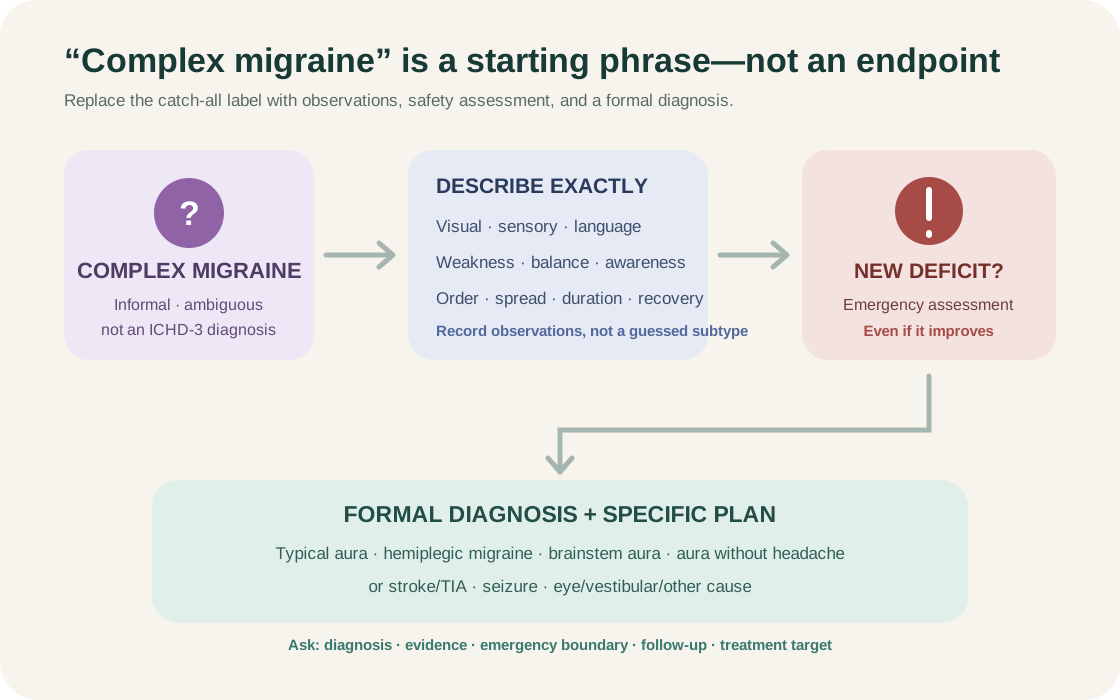
Complex migraine symptoms
There is no official symptom list because there is no official diagnosis. Events given this label may include:
- visual aura: zigzags, shimmering, flashes, or a spreading blind area;
- sensory aura: pins and needles followed by numbness, often spreading along one hand, arm, or face;
- speech/language aura: difficulty finding, producing, or understanding words;
- motor weakness on one side;
- vertigo, slurred speech, double vision, tinnitus, reduced hearing, poor coordination, or reduced consciousness;
- confusion or difficulty thinking; and
- headache, nausea, light/sound sensitivity, or no head pain at all.
These symptoms overlap with stroke/TIA, seizure, vestibular disease, metabolic disturbance, infection, medication effects, and other disorders. The symptom list therefore cannot convert “complex migraine” into a safe self-diagnosis.
Formal diagnoses the label may be hiding
ICHD-3 offers specific categories based on what happened—not on how dramatic it felt.
| Possible formal category | Defining idea | Important boundary |
|---|---|---|
| Migraine with typical aura | Fully reversible visual, sensory, and/or speech-language symptoms, without motor or brainstem features | Usually gradual and sequential; still assess first/new deficits |
| Hemiplegic migraine | Migraine with aura that includes fully reversible motor weakness | Stroke must be excluded; familial and sporadic forms exist |
| Migraine with brainstem aura | At least two specified reversible brainstem symptoms, without motor or retinal symptoms | “Dizziness” alone is not enough; weakness points elsewhere |
| Typical aura without headache | Typical aura occurs without a following migraine-type headache | New aura without headache can resemble TIA or seizure |
| Retinal migraine | Repeated, reversible visual disturbance verified in one eye after exclusion of other causes | Extremely rare; one-eye loss needs urgent assessment |
| Probable migraine with aura | An otherwise aura-like pattern misses one formal criterion | “Probable” is a clinician classification, not uncertainty to ignore |
A person may have more than one migraine phenotype. The correct label can also change as repeated attacks clarify the pattern or testing reveals another explanation.
Typical migraine aura
ICHD-3 migraine with aura describes recurrent, fully reversible visual, sensory, speech/language, motor, brainstem, or retinal symptoms. The general criteria emphasize gradual spread over at least five minutes, symptoms occurring in succession, 5–60-minute duration for most individual symptoms, unilateral or positive phenomena, and headache within 60 minutes; at least three of six listed characteristics are required.
Typical aura is restricted to visual, sensory, and speech/language symptoms with no motor weakness or brainstem features. Visual change often starts small and expands; sensory tingling may travel before numbness; language difficulty may follow. These tendencies help clinicians, but a stroke can have variable evolution and migraine can start suddenly. Timing is evidence, not a home rule-out test. See the full migraine aura guide.
Hemiplegic migraine
Hemiplegic migraine is migraine with aura that includes fully reversible motor weakness. It can be familial, when a close relative has qualifying attacks, or sporadic. Other visual, sensory, or language aura commonly accompanies weakness. Motor symptoms often last less than 72 hours but may persist longer in some people.
One-sided weakness is also a core stroke sign. A prior hemiplegic-migraine diagnosis does not make every future weakness episode safe, especially if the onset, duration, side, accompanying symptoms, or recovery differs. Emergency clinicians may need examination and imaging before treating an event as familiar migraine. Read the dedicated hemiplegic migraine guide for the formal criteria, family-history subtypes, and individualized emergency plan.
Migraine with brainstem aura
Migraine with brainstem aura requires at least two fully reversible brainstem symptoms from a defined list: slurred speech (dysarthria), true spinning vertigo, tinnitus, reduced hearing, double vision, impaired coordination, or reduced consciousness. It specifically excludes motor weakness and retinal symptoms.
Several everyday descriptions are not equivalent to those criteria. Lightheadedness is not necessarily vertigo; blurred vision is not double vision; ear fullness is not reduced hearing; word-finding difficulty is not the same as slurred articulation. Anxiety and hyperventilation can also resemble some brainstem symptoms. Precise wording and examination matter.
Migraine aura vs. stroke or TIA
Migraine aura often builds gradually, adds positive symptoms such as shimmering or tingling, and moves from one modality to another. Stroke/TIA is often described as a sudden loss of function such as weakness, numbness, vision loss, or language impairment. But real presentations overlap: aura can be abrupt or negative, while ischemic symptoms can evolve.
Use FAST—face droop, arm weakness, speech difficulty, time to call emergency services—as an action prompt, not a diagnostic comparison. Additional warning signs include sudden visual loss, severe imbalance, confusion, collapse, or a new intense headache. Symptoms that resolve can still represent TIA and need urgent assessment.
Migraine aura vs. seizure
Focal seizures can cause visual, sensory, language, motor, or awareness changes. They are often brief and stereotyped and may include jerking, forced head/eye movement, behavioral arrest, loss of awareness, or a post-event confused period. Migraine aura more often develops over minutes and lasts longer, but duration alone does not separate them reliably.
A first seizure, prolonged seizure, repeated seizures without recovery, injury, breathing problem, or persistent confusion needs emergency care. Do not put objects in the mouth or restrain convulsive movement. A clinician may use witness description, examination, brain imaging, EEG, and the longitudinal pattern to investigate.
How clinicians clarify a complex migraine label
Evaluation starts with the exact event sequence: what appeared first, whether symptoms spread, which side or visual field was affected, duration of each symptom, headache timing, and degree of recovery. Examination during symptoms can be especially informative.
Testing is selected for the differential and context. Depending on the presentation, clinicians may use brain imaging, vascular imaging, blood tests, electrocardiography, cardiac monitoring, EEG, eye examination, or genetic testing. Not every person needs every test, and a normal scan does not by itself prove migraine.
The history should include age at first event, vascular risks, pregnancy/postpartum context, estrogen-containing contraception, smoking/nicotine, recent infection or injury, seizure history, family migraine/stroke/seizure history, and all medicines/substances.
Complex migraine treatment
There is no treatment for “complex migraine” as a single entity because the term has no standardized criteria. Treatment follows the formal diagnosis and the person’s risks.
After urgent alternatives are excluded, a plan may include an acute migraine medicine, nausea treatment, a preventive medicine when attacks are frequent or disabling, lifestyle regularity, and a written emergency boundary. Medicine choice differs when aura includes motor or brainstem symptoms, when cardiovascular risks exist, during pregnancy, and when the diagnosis remains uncertain. Evidence for rare subtypes is limited because they are often excluded from large trials.
Do not start, stop, or borrow triptans, ergots, aspirin, antiseizure drugs, or preventive medicine based on an ambiguous label. Ask the prescriber which formal diagnosis the treatment targets, what benefit to measure, what adverse effects matter, and what symptoms should override the usual home plan.
A clinician clarification checklist
At follow-up, bring the exact chart wording and ask:
- Was “complex migraine” descriptive shorthand or the final diagnosis?
- Which ICHD-3 diagnosis and code best fits now?
- Which findings supported migraine, and which alternatives were evaluated?
- Were the symptoms visual, sensory, language, motor, brainstem, retinal, seizure-like, or something else?
- Which recurrence can follow the home plan, and which change means emergency care?
- What acute and preventive treatment is appropriate for this subtype?
- Is neurology, stroke, epilepsy, eye, vestibular, or genetic follow-up needed?
Request an updated problem-list entry if the work-up produced a more precise diagnosis. Keeping an obsolete shorthand label can create confusion across emergency, primary-care, and specialist records.
How to record an event without diagnosing it
Record observations in real time only when safety allows:
- exact start and end for each symptom;
- sudden versus gradual onset and any spread;
- order: visual, sensory, language, weakness, balance, headache;
- exact side, body part, and visual field;
- positive symptoms (flashing/tingling/jerking) versus lost function;
- ability to smile, lift both arms, speak, walk, and stay alert—without delaying emergency action;
- witness description, photos/video only if safe and consented;
- medicine taken, response, and full/partial recovery; and
- what was different from earlier events.
Keep “complex migraine” in a separate clinician-label field. Calmraine can preserve a timeline; it cannot decide whether an episode was aura, stroke, TIA, or seizure.
Frequently asked questions
Is complex migraine a real diagnosis?
No. The symptoms can be real and severe, but “complex migraine” is not an ICHD-3 diagnostic category. Ask which formal diagnosis was intended.
Is complex migraine the same as hemiplegic migraine?
Not necessarily. Hemiplegic migraine has specific criteria and includes motor weakness. “Complex migraine” may have been used for typical aura, brainstem symptoms, confusion, or another unresolved event.
Can complex migraine look like a stroke?
Yes, neurological migraine symptoms can overlap with stroke/TIA. New or changed weakness, speech difficulty, facial droop, vision loss, or severe imbalance requires emergency assessment rather than home comparison.
How long do complex migraine symptoms last?
There is no standardized duration. Most individual aura symptoms are classified in a 5–60-minute range, while motor weakness can last up to 72 hours or longer. A duration outside those ranges does not reveal the cause.
Can complex migraine happen without a headache?
Aura can occur without headache. A new neurological episode without headache still needs assessment because TIA, seizure, and other conditions can present that way.
The practical takeaway
“Complex migraine” tells you that an event was difficult to describe, not what diagnosis was established. Translate the label into exact visual, sensory, language, motor, brainstem, awareness, and headache details. Treat new or changed neurological loss as an emergency. After urgent causes are addressed, ask for the intended ICHD-3 diagnosis, the evidence behind it, the recurrence boundary, and a diagnosis-specific treatment plan.
For context, read types of migraine, silent migraine, and the medical disclaimer.
Calmraine provides educational information and cannot classify neurological symptoms. Read the medical disclaimer.
Sources
- What is Complex Migraine?National Headache Foundation · Accessed
- 1.2 Migraine with auraInternational Headache Society · Accessed
- 1.2.2 Migraine with brainstem auraInternational Headache Society · Accessed
- 1.2.3 Hemiplegic migraineInternational Headache Society · Accessed
- MigraineNational Institute of Neurological Disorders and Stroke · Accessed
- Stroke—First aidMayo Clinic · Accessed
- Symptoms of a strokeNHS · Accessed