
Hemiplegic migraine is a rare type of migraine with aura that includes reversible muscle weakness. The weakness is often on one side. Visual, sensory, or speech-language symptoms may also occur. The formal definition requires fully reversible motor weakness, but a new episode can look like stroke, TIA, seizure, or infection. A migraine history does not make new weakness safe to diagnose at home.
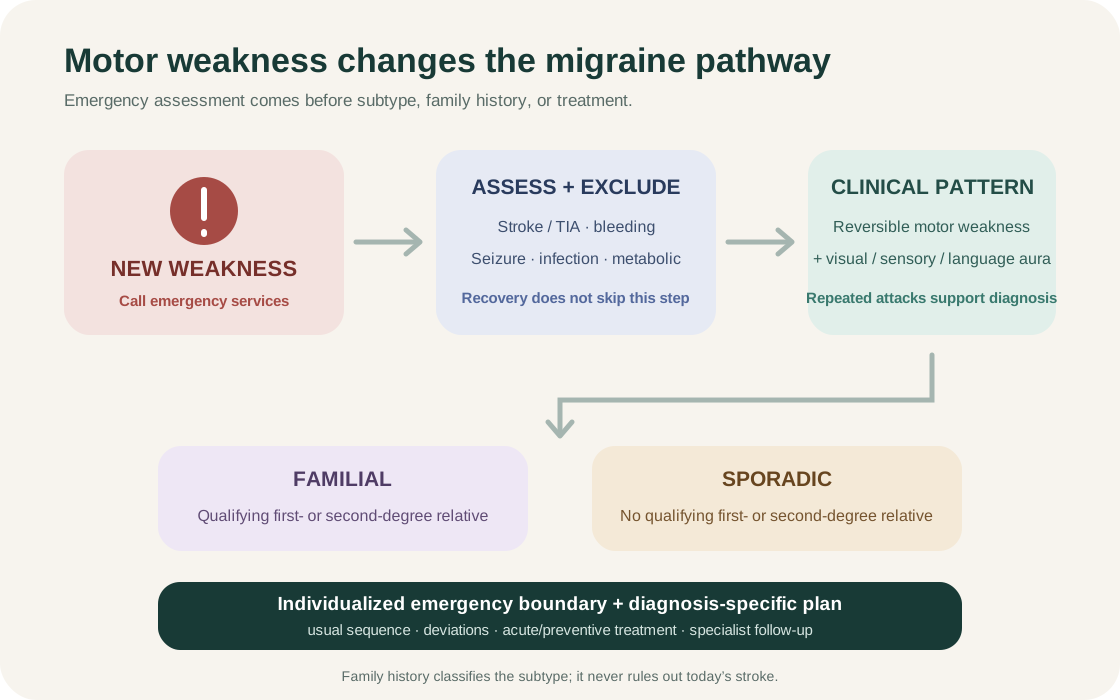
Call emergency services immediately for new or sudden facial droop; arm or leg weakness/paralysis; speech or language trouble; confusion; severe imbalance; fainting; seizure; or sudden vision loss. Do not drive, wait for headache, or wait to see whether symptoms resolve. Follow a specialist’s individualized emergency plan for a previously diagnosed recurring pattern, but seek emergency help for any deviation or uncertainty.
What is hemiplegic migraine?
Hemiplegic migraine is migraine with aura in which motor weakness is part of the aura. “Hemiplegic” refers to weakness affecting one side, although the degree can range from mild clumsiness or heaviness to profound loss of movement. Visual, sensory, or language aura must also occur under the ICHD-3 definition.
The weakness is reversible. It commonly lasts less than 72 hours, but ICHD-3 notes that it can persist for weeks in some people. Headache may start before, during, or after the motor aura and can be absent in an individual event. Recovery does not retrospectively prove the event was migraine because TIA and seizure-related weakness can also improve.
Hemiplegic migraine symptoms
Motor aura can affect the face, arm, and leg on one side, with difficulty lifting, gripping, walking, speaking clearly, or coordinating movement. It may spread gradually from one area to another. Sensory numbness can feel like weakness, and the two can coexist, so clinicians focus on actual lost motor function.
Other reversible aura symptoms may include:
- shimmering, zigzag, blind, or distorted areas of vision;
- pins and needles followed by numbness;
- word-finding, speaking, reading, or understanding difficulty;
- vertigo, double vision, slurred speech, poor coordination, or reduced alertness in some attacks;
- headache, nausea, vomiting, and light/sound sensitivity; and
- confusion, drowsiness, fever, or seizures in severe attacks, particularly in some genetic forms.
Symptoms can evolve over minutes and occur in succession, but a sudden event can still be hemiplegic migraine and a gradual event can still be ischemic. Pattern recognition never replaces emergency assessment for a first or changed deficit.
Formal diagnostic criteria
ICHD-3 requires attacks meeting migraine-with-aura criteria, with aura consisting of both:
- Fully reversible motor weakness.
- Fully reversible visual, sensory, and/or speech-language symptoms.
At least two qualifying attacks are generally needed for a definite recurrent migraine diagnosis. The broader aura criteria consider gradual spread, symptom succession, duration, laterality, positive symptoms, and headache timing. Motor symptoms often last longer than the usual 5–60-minute window applied to most non-motor aura.
These are clinician-facing classification rules. No one should wait for a second weakness episode to seek care or use a checklist to overrule emergency stroke protocols.
Familial vs. sporadic hemiplegic migraine
Familial hemiplegic migraine (FHM) is diagnosed when at least one first- or second-degree relative has attacks meeting hemiplegic-migraine criteria. Sporadic hemiplegic migraine (SHM) has the same clinical attack pattern but no qualifying first- or second-degree relative.
The labels describe family history, not symptom intensity. A sporadic case can have a pathogenic variant, and a relative may later develop qualifying attacks, changing the classification. Conversely, a strong family story does not prove that today’s weakness is migraine.
Known FHM subtypes involve variants in genes including CACNA1A, ATP1A2, SCN1A, and, in a smaller group, PRRT2. Many clinically diagnosed people do not have an identified pathogenic variant. Genetic testing is not a universal yes/no test for hemiplegic migraine.
| Subtype | Gene | Protein affected | Notable features |
|---|---|---|---|
| FHM1 | CACNA1A | Voltage-gated calcium channel (CaV2.1) | Most common identified subtype; cerebellar signs or ataxia in some families |
| FHM2 | ATP1A2 | Na+/K+ ATPase pump | Sometimes associated with epilepsy or intellectual disability in rare variants |
| FHM3 | SCN1A | Voltage-gated sodium channel (Nav1.1) | Also associated with Dravet syndrome variants; seizure overlap |
| FHM4 / PRRT2 | PRRT2 | Proline-rich transmembrane protein | Reported in a smaller group; also linked to paroxysmal kinesigenic dyskinesia |
| Sporadic (SHM) | Not identified | Unknown or multiple | Same clinical pattern; no qualifying family history; some carry the above variants |
Classification here refers to genetic subtype, not severity. Many people with a clinical HM diagnosis have none of the above identified variants.
Hemiplegic migraine vs. stroke or TIA
Migraine aura often adds positive symptoms, spreads gradually, and moves from visual to sensory to language or motor domains. Stroke/TIA often produces sudden lost function. But the overlap is substantial: migraine can be abrupt and negative, while ischemia can evolve or include headache.
Use FAST—face droop, arm weakness, speech difficulty, time to call emergency services—as an action rule. Do not use age, a migraine history, gradual onset, or improvement to decide against calling. Emergency assessment protects the time window for stroke treatment and can identify hemorrhage, dissection, venous thrombosis, RCVS, or other vascular disease.
Hemiplegic migraine vs. seizure
Focal seizures can cause jerking, posturing, sensory or visual symptoms, speech arrest, or altered awareness. Weakness can follow a seizure (Todd paralysis) and last minutes to hours or longer. Severe hemiplegic-migraine attacks can also include seizures, and some causal genes overlap with epilepsy biology.
Witness detail is valuable: forced eye/head movement, rhythmic jerking, behavioral arrest, loss of awareness, tongue injury, incontinence, and the recovery sequence. EEG may help when seizure is suspected, but an interictal EEG can be normal. A first seizure, prolonged seizure, repeated seizures without recovery, injury, or breathing difficulty needs emergency care.
Other conditions that can look similar
The differential includes low glucose, infection/encephalitis, inflammatory disease, brain tumor, metabolic or mitochondrial disorders, HaNDL (transient headache and neurological deficits with cerebrospinal-fluid lymphocytosis), Bell palsy, functional neurological disorder, and other migraine variants.
In children, alternating hemiplegia of childhood, epilepsy syndromes, infection, stroke, and metabolic/genetic disorders require careful consideration. A diagnostic label should emerge from examination, event chronology, and appropriate tests—not merely from normal initial imaging.
How hemiplegic migraine is diagnosed
Diagnosis is clinical and longitudinal. The clinician records what function was lost, how symptoms spread, the order/duration of aura components, headache relationship, recovery, earlier attacks, and family history. Neurological examination during symptoms is particularly useful.
Brain and vascular imaging commonly exclude stroke, bleeding, dissection, tumor, or other structural causes, especially for first or sporadic events. Blood tests can evaluate metabolic/infectious contexts. Lumbar puncture may be needed when infection, inflammation, or HaNDL is suspected. EEG is considered for seizure-like events.
Imaging during an attack can be normal or show reversible changes; neither pattern alone confirms the diagnosis. Emergency teams make time-sensitive treatment decisions from the full stroke evaluation, not an online migraine comparison.
When genetic testing is useful
A neurologist or genetic counselor may consider testing when there is a strong multigenerational family history, very early onset, severe/prolonged attacks, seizures, impaired consciousness, cerebellar signs, developmental concerns, or another syndrome suggesting a known gene.
Testing can clarify a subtype, guide family counseling, or prompt monitoring for gene-associated features. A negative panel does not exclude clinical hemiplegic migraine; a variant of uncertain significance is not a confirmed cause. Testing relatives and interpreting inheritance should happen with consent and counseling because results can affect family members and insurance/privacy considerations by jurisdiction.
What causes hemiplegic migraine?
Hemiplegic migraine appears to involve abnormal neuronal ion transport and a lower threshold for cortical spreading depolarization—the wave of altered electrical/chemical activity associated with aura. Known FHM genes encode ion channels or transport proteins, supporting this model.
That does not mean every attack has a known genetic cause. Sleep disruption, stress, bright light, illness, hormonal changes, foods, or minor head trauma are reported around attacks, but triggers vary. Severe attacks after minor trauma have been described in some genetic subtypes; a person with that history needs specialist safety guidance rather than universal activity restriction.
Hemiplegic migraine treatment
Randomized controlled trials are lacking because the condition is rare and people with hemiplegic migraine have often been excluded from migraine trials. Treatment is individualized and divided into emergency/acute management and prevention.
During a first or atypical attack, emergency care prioritizes excluding and treating stroke, seizure, infection, or metabolic problems. Severe/prolonged aura, reduced consciousness, fever, repeated vomiting, dehydration, or seizure may require hospital monitoring and supportive treatment.
After diagnosis, clinicians may use non-vasoconstrictive acute pain and nausea treatments. Preventive reports include verapamil, acetazolamide, lamotrigine, flunarizine where available, topiramate, valproate, and other migraine preventives. The evidence for each is limited, and gene/phenotype, pregnancy potential, seizure history, blood pressure, kidney/liver health, and interactions affect choice.
What about triptans and ergots?
Ergot derivatives and triptans have historically been avoided or labeled contraindicated because of vasoconstriction concerns and trial exclusion. Retrospective reports describe some benefit from triptans without establishing safety in this rare population, so the question remains debated rather than settled by strong trials.
Do not start, stop, or borrow these medicines from an online discussion. Ask a headache specialist to document whether they are appropriate for the confirmed phenotype and vascular history, and what alternative acute plan to use.
Building an individualized emergency plan
A written plan should not simply say “this is migraine.” It should identify:
- The confirmed diagnosis and specialist contact.
- The person’s usual aura order, side, duration, and recovery.
- Which familiar recurrence can follow the agreed home/urgent plan.
- Which deviation—new side, sudden onset, longer duration, different function, seizure, incomplete recovery—requires emergency services.
- Acute medicines and exact contraindications supplied by the prescriber.
- What family, school, work, and emergency clinicians should know.
Carry a concise copy, but never let the card delay emergency assessment. Stroke can occur in a person who also has hemiplegic migraine.
How to track an attack after care is underway
Record actual function rather than repeatedly testing strength: “cup dropped,” “could not lift left arm,” or “needed help walking.” Add the start/end and recovery milestones for face, arm, leg, speech, vision, sensation, awareness, headache, nausea, and seizure-like activity.
Note first versus familiar pattern, symptom order/spread, side, emergency call/arrival, tests, medicine, and residual symptoms. Preserve clinician wording separately from observations. Calmraine can store the event sequence; it cannot determine whether weakness is motor, sensory, migraine, stroke, or seizure.
Frequently asked questions
Is hemiplegic migraine a stroke?
No, it is a migraine-with-aura subtype, but symptoms can be indistinguishable at home and stroke can occur in the same person. New or changed weakness needs emergency assessment.
How long does hemiplegic migraine weakness last?
Motor symptoms commonly last less than 72 hours but can persist for weeks. Duration does not prove the cause, and incomplete recovery needs urgent reassessment.
Is hemiplegic migraine hereditary?
Familial hemiplegic migraine follows a qualifying family pattern and may involve known gene variants. Sporadic cases lack that family history, although some have pathogenic variants. Many cases have no identified variant.
Can hemiplegic migraine occur without headache?
Yes, the motor and other aura can occur without a typical headache in an individual attack. Absence of pain does not reduce the stroke/TIA urgency of new weakness.
Can children have hemiplegic migraine?
Yes. It can begin in childhood or adolescence. Pediatric weakness, altered awareness, fever, or seizure requires urgent assessment and specialist consideration of vascular, infectious, epileptic, metabolic, and genetic alternatives.
The practical takeaway
Hemiplegic migraine is migraine with aura that includes reversible motor weakness plus visual, sensory, and/or language symptoms. Familial and sporadic forms describe family history; genetic testing may clarify selected cases but is not a universal diagnostic answer. New or changed weakness is emergency-first because stroke and seizure overlap. Once specialist diagnosis is established, a written emergency boundary, individualized acute/preventive plan, and function-by-function timeline make future care safer and more precise.
For terminology context, read complex migraine, migraine aura, and the medical disclaimer.
Calmraine provides educational information and cannot assess weakness or distinguish migraine from stroke. Read the medical disclaimer.
Sources
- 1.2.3 Hemiplegic migraineInternational Headache Society · Accessed
- 1.2.3.1 Familial hemiplegic migraineInternational Headache Society · Accessed
- 1.2.3.2 Sporadic hemiplegic migraineInternational Headache Society · Accessed
- Hemiplegic Migraine: Symptoms & TreatmentsAmerican Migraine Foundation · Accessed
- Diagnostic and therapeutic aspects of hemiplegic migraineJournal of Neurology, Neurosurgery & Psychiatry / PubMed Central · Accessed
- Headache—Hope through researchNational Institute of Neurological Disorders and Stroke · Accessed
- Symptoms of a strokeNHS · Accessed
- Hemiplegic Migraine in Children and AdolescentsJournal of Clinical Medicine / PubMed Central · Accessed