
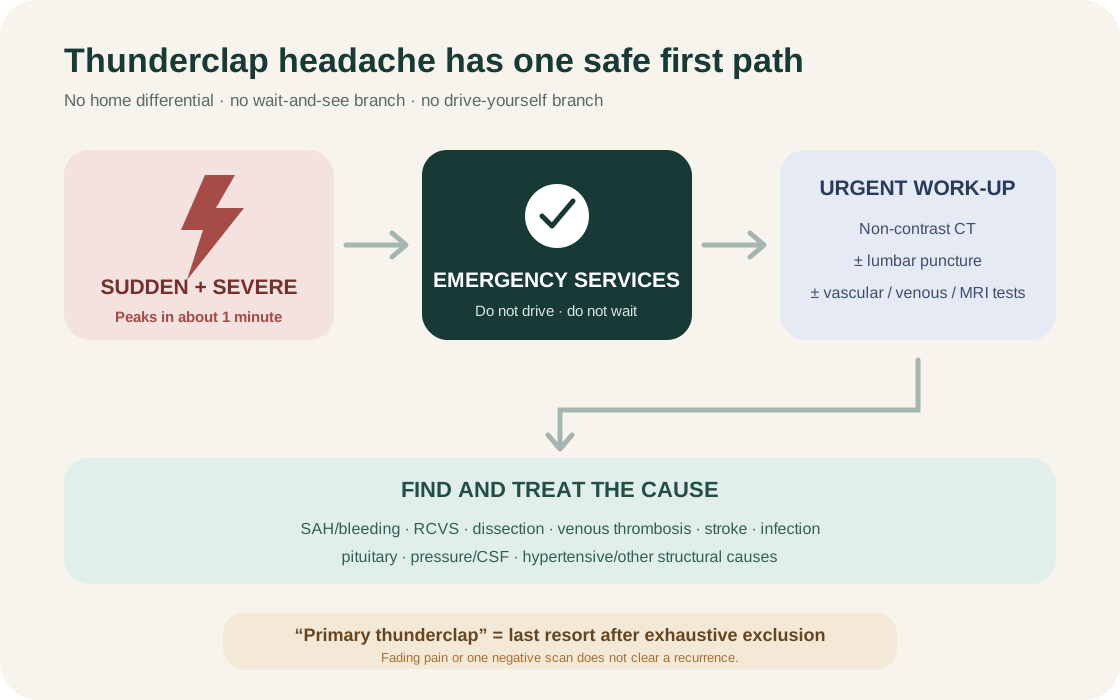
Call emergency services now for a sudden severe headache that reaches maximum intensity within seconds to about one minute. This rapid peak defines the thunderclap pattern. Do not drive yourself. Do not wait for the pain to fade or for another symptom. If you are with the person, call and follow the dispatcher’s instructions.
This remains urgent even if the person has migraine, the pain began during exercise or straining, or the symptoms improve. A thunderclap headache is a symptom pattern, not a diagnosis. Potentially life-threatening causes must be excluded immediately.
What is a thunderclap headache?
A thunderclap headache is severe head pain with an explosive or abrupt onset that peaks almost immediately. Mayo Clinic uses a peak within 60 seconds. NICE describes sudden severe headache typically peaking within one to five minutes in its subarachnoid-hemorrhage guidance.
Do not use the small wording difference as a stopwatch test. People estimate time poorly during extreme pain, and dangerous sudden headaches do not become safe at 61 seconds. “Worst headache of my life” is a warning phrase, but a thunderclap can be dangerous even if a person has experienced worse pain before.
Thunderclap headache symptoms
The defining feature is the onset-to-peak clock, not a particular location or quality. Pain may be generalized, one-sided, at the back of the head/neck, or elsewhere. It may be accompanied by nausea, vomiting, neck pain or stiffness, light sensitivity, or no other symptom.
Additional emergency signs include:
- loss of consciousness, collapse, confusion, or unusual drowsiness;
- seizure;
- weakness, numbness, facial droop, speech/language trouble, or severe imbalance;
- double vision or sudden visual loss;
- fever, rash, or marked neck stiffness;
- chest pain, severe shortness of breath, or very high blood-pressure symptoms;
- recent head/neck injury; and
- pregnancy or the first weeks after birth.
Do not wait for any of these additions. Sudden severe pain alone is enough to seek emergency assessment.
Why thunderclap headache is an emergency
The classic concern is subarachnoid hemorrhage (SAH), often from a ruptured aneurysm. Delay can allow rebleeding, stroke, hydrocephalus, seizure, or death. Thunderclap headache can also signal other vascular and neurological disorders that require time-sensitive treatment.
Pain improvement is not reassurance. A small aneurysmal “warning leak,” TIA-like vascular event, or RCVS headache can resolve before complications occur. Likewise, normal vital signs or the ability to speak and walk do not exclude bleeding.
Thunderclap headache causes
Important secondary causes, roughly from most urgent to evaluate:
| Cause | What it involves | Key clinical clues |
|---|---|---|
| Aneurysmal subarachnoid hemorrhage (SAH) | Rupture of a cerebral aneurysm; blood in subarachnoid space | “Worst headache of life”; may include brief loss of consciousness, meningism, vomiting |
| Non-aneurysmal SAH | Perimesencephalic bleeding without identified aneurysm | Same presentation; still requires full workup |
| Reversible cerebral vasoconstriction syndrome (RCVS) | Segmental arterial narrowing; recurrent thunderclap attacks | Multiple attacks over days–weeks; triggered by exertion, sex, bathing; postpartum association |
| Cervical / intracranial arterial dissection | Tear in arterial wall; can cause ischemia | Neck pain, pulsatile tinnitus, Homer syndrome, new stroke symptoms |
| Cerebral venous sinus thrombosis (CVST) | Venous clot; can cause hemorrhage or raised pressure | Subacute onset possible; headache may worsen with Valsalva; pregnancy/contraceptive risk |
| Ischemic stroke | Sudden loss of blood supply | Focal neurological deficit; FAST symptoms; thunderclap onset is less typical but occurs |
| Pituitary apoplexy | Hemorrhage or infarction of a pituitary tumor | Severe headache; visual field loss; oculomotor palsy; hormonal collapse |
| Hypertensive emergency / PRES | Severely elevated blood pressure; posterior reversible encephalopathy | Very high BP reading; visual changes; seizure; posterior white-matter changes on MRI |
| Meningitis / encephalitis | Bacterial, viral, or other CNS infection | Fever; meningism (neck stiffness, photophobia, Kernig/Brudzinski signs); altered consciousness |
| Spontaneous intracranial hypotension | CSF leak; low intracranial pressure | Orthostatic component (worse upright, better lying); post-lumbar puncture or spontaneous |
| Primary thunderclap headache | A diagnosis of exclusion — the above causes must be demonstrably ruled out first | Fully normal and exhaustive evaluation; recurrence still needs assessment |
The trigger does not determine the cause. Exercise, orgasm, coughing, bathing, emotional stress, or bending can precede primary headaches and SAH, RCVS, dissection, or other vascular events.
What is RCVS?
Reversible cerebral vasoconstriction syndrome involves segmental narrowing of cerebral arteries that resolves over time. A classic presentation is recurrent thunderclap headaches over days to a few weeks, sometimes triggered by exertion, sex, coughing/straining, bathing, or emotion. Neurological deficits or seizures can occur, and complications include ischemic stroke, convexity SAH, and other hemorrhage.
RCVS can arise without a clear trigger and has associations with postpartum physiology and vasoactive substances/medicines. Tell clinicians about prescription and over-the-counter decongestants/stimulants, serotonergic or adrenergic medicines, cannabis, cocaine/amphetamines, and recent medication changes—without stopping prescribed medicine unless the treating team directs it.
Early vascular imaging can be normal because vasoconstriction may become clearer later. A second thunderclap after an initial negative evaluation is therefore another emergency, not proof that the first test “cleared” all future events.
How emergency clinicians evaluate thunderclap headache
Assessment starts with exact onset time, examination, vital signs, medication/substance and pregnancy/postpartum history, and urgent brain imaging. NICE recommends urgent non-contrast CT when a senior clinical decision-maker confirms unexplained thunderclap headache or other SAH features.
The sensitivity of CT for SAH is highest early and depends on scanner, interpretation, timing, and clinical context. When CT is negative but SAH remains a concern, clinicians may use lumbar puncture according to timing/protocol. CT angiography, MRI/MRA, MR venography, catheter angiography, or repeat vascular imaging may be selected for aneurysm, RCVS, dissection, venous thrombosis, ischemia, pituitary, pressure, or other suspected causes.
Do not use an online “six-hour rule” to decide against care or to interpret a result yourself. The emergency team integrates test quality, timing, examination, and the remaining differential.
What happens after a negative first scan?
A negative initial CT is good information, not a universal discharge diagnosis. Next steps depend on when the scan occurred, whether SAH is still suspected, whether vascular imaging was performed, neurological findings, recurrent thunderclaps, and other cause-specific clues.
Ask the treating team:
- Which dangerous causes were evaluated and which remain possible?
- Was vascular/venous imaging needed or completed?
- Is lumbar puncture or repeat imaging indicated?
- What symptoms or recurrence mean immediate return?
- Should any medicine/substance or activity be avoided pending follow-up?
- Which specialist and timeframe apply?
Do not return to the triggering activity merely because pain stopped or the first scan was normal.
Can migraine cause a thunderclap headache?
Migraine can occasionally present with sudden severe pain, and people with migraine can also develop SAH, RCVS, dissection, or another secondary headache. A familiar migraine history cannot safely explain a thunderclap at home.
If emergency evaluation excludes secondary causes, clinicians may later decide that the attack fits a primary migraine or another primary headache. That retrospective diagnosis does not change the correct emergency response at onset.
Primary thunderclap headache
ICHD-3 says primary thunderclap headache should be a diagnosis of last resort, reached only when organic causes have been demonstrably excluded. It calls the search for an underlying cause expedited and exhaustive and notes that evidence for a distinct primary disorder is poor.
This means “all tests were normal” may describe an unresolved event rather than a durable benign condition. Follow the discharge plan, complete recommended follow-up, and return immediately for recurrence or new neurological/systemic symptoms.
Thunderclap headache treatment
There is no single thunderclap-headache treatment. Emergency treatment targets the discovered cause: aneurysm and bleeding care, stroke pathways, RCVS management and trigger review, anticoagulation for selected venous thrombosis, antibiotics for bacterial meningitis, pituitary/endocrine treatment, blood-pressure management, or other cause-specific care.
Do not take extra aspirin, NSAIDs, triptans, ergots, stimulants, or someone else’s migraine medicine before emergency assessment unless a dispatcher/clinician instructs you. Some can worsen bleeding risk or complicate a suspected vascular condition. Do not eat or drink if the emergency team advises against it because procedures may be needed.
What a witness should record after calling
The emergency call comes first. Without delaying care, a witness can preserve:
- exact or estimated onset time and time to peak;
- the person’s first words and what they were doing;
- collapse, seizure, weakness, speech, vision, balance, fever, or neck symptoms;
- pregnancy/postpartum status and recent injury;
- prescribed/OTC medicines, supplements, stimulants, recreational substances, and anticoagulants;
- prior thunderclaps and where/when they were evaluated; and
- emergency call, arrival, test, and symptom-change times.
Do not flex the person’s neck, provoke exertion, perform repeated strength tests, or interrogate someone in severe pain. Give the medication list or containers to responders if readily available.
Frequently asked questions
Is every sudden headache a thunderclap headache?
Thunderclap refers to severe pain reaching maximum intensity extremely rapidly. Because timing and severity are hard to judge and dangerous causes overlap, any new sudden severe headache deserves emergency assessment.
Can a thunderclap headache go away on its own?
Yes, the pain can improve even when the cause remains dangerous. Improvement does not rule out bleeding, RCVS, TIA/stroke, or another vascular disorder.
What if I had a normal CT scan?
Follow the treating team’s explanation of timing and remaining differential. A negative CT may need cause-specific follow-up, lumbar puncture, vascular/venous imaging, or repeat imaging. Any recurrent thunderclap is an emergency.
Can exertion or sex cause thunderclap headache?
They can trigger both primary and secondary headaches, including RCVS and SAH. The trigger does not make the event benign. Stop and seek emergency care.
Can a person have repeated thunderclap headaches?
Yes. Recurrent attacks over days or weeks are characteristic of RCVS but can have other causes. Each recurrence needs urgent evaluation under the treating team’s plan.
The practical takeaway
A thunderclap headache is a sudden severe headache that peaks within about one minute; clinically, slightly broader wording is used, so do not wait on a stopwatch. Call emergency services immediately and do not drive. Emergency clinicians use urgent imaging and cause-specific tests to investigate SAH, RCVS, dissection, venous thrombosis, stroke, infection, pituitary and pressure disorders, and other causes. “Primary thunderclap headache” is a last-resort diagnosis only after exhaustive exclusion. A negative first scan or fading pain never makes a recurrent thunderclap safe to ignore.
For adjacent safety context, read exertion headache and different kinds of headaches only after urgent care is underway.
Call emergency services now. Calmraine cannot assess a thunderclap headache. Read the medical disclaimer only after urgent care is underway.
Sources
- 4.4 Primary thunderclap headacheInternational Headache Society · Accessed
- Subarachnoid haemorrhage caused by a ruptured aneurysm—RecommendationsNICE · Accessed
- Thunderclap headaches—Symptoms and causesMayo Clinic · Accessed
- Headache—Hope through researchNational Institute of Neurological Disorders and Stroke · Accessed
- Reversible Cerebral Vasoconstriction Syndrome, Part 1: Epidemiology, Pathogenesis, and Clinical CourseAmerican Journal of Neuroradiology / PubMed Central · Accessed
- Headache Attributed to Reversible Cerebral Vasoconstriction SyndromeJournal of Clinical Medicine / PubMed Central · Accessed